Quick Verdict: Top Picks
- Spec Score 8.8/10EcoFlow DELTA 3 PlusFast switchover (under 10 ms), 56-minute wall recharge, 1,000 W of solar input and expansion to 5 kWh.Check Price for EcoFlow DELTA 3 Plus (opens Amazon in a new tab)
Picks are based on the manufacturer specs and the math in this guide. Prices change often, so check the current price on Amazon.
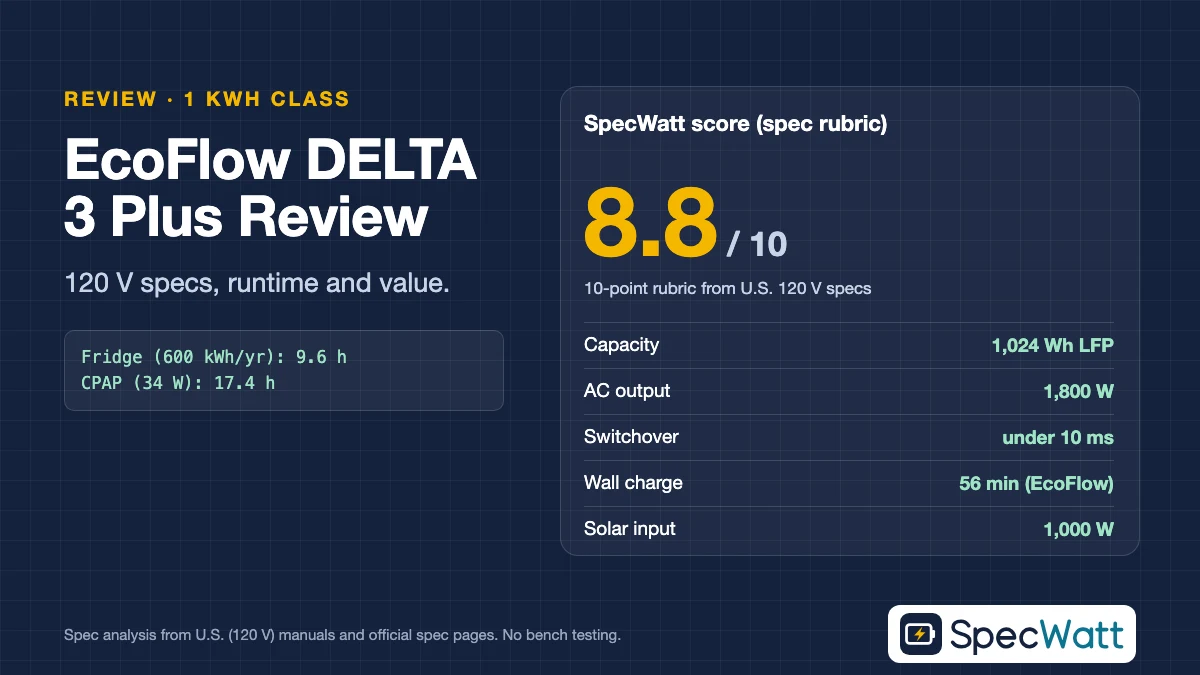
Our EcoFlow DELTA 3 Plus review gives it 8.8 out of 10. On paper it’s one of the most complete 1 kWh stations we’ve compared: a switchover under 10 ms, a 56-minute wall recharge, two 500 W solar inputs and a path to 5 kWh of storage. What holds it back is price per watt-hour, which was about $0.70 at EcoFlow’s U.S. store on November 19, 2026.
This is a spec-sheet review, not a bench test. Every number comes from the Specs table on EcoFlow’s U.S. product page, read on November 19, 2026, and every runtime uses the same open formula as our runtime calculator. The score follows the 10-point rubric shown below, applied the same way to every station we review.
Our Score: 8.8 out of 10
The table breaks this EcoFlow DELTA 3 Plus review score into its ten rubric lines. Each line is based on a published spec, so you can check our reasoning and reweigh any category that matters more or less for your own plan.
| Rubric line (max points) | Score | Spec behind it |
|---|---|---|
| Capacity (1) | 0.5 | 1,024 Wh, the 1 kWh class |
| AC output (1) | 1 | 1,800 W continuous, 3,600 W surge |
| Wall charging (1) | 1 | Full in 56 minutes at 1,500 W, per EcoFlow |
| Solar input (1) | 1 | 2 × 500 W, 11–60 V (1,000 W) |
| Outage switchover (1) | 1 | UPS under 10 ms |
| Portability (1) | 0.75 | About 37 Wh per lb (27.6 lb) |
| Chemistry and cycles (1) | 1 | LFP, 4,000 cycles to 80% |
| Warranty (1) | 1 | 5 years |
| Value (1.5) | 1 | Official-store price per Wh (price and date in the text) |
| Expansion (0.5) | 0.5 | Up to 5 kWh with an extra battery |
| Total | 8.75 → 8.8 |
The DELTA 3 Plus loses points in only three places: its capacity is in the 1 kWh class, its weight per watt-hour is average, and its price per watt-hour is higher than the cheapest 1 kWh stations we’ve compared. On every speed and safety line, including switchover, charging, solar and warranty, it earns full marks.
EcoFlow DELTA 3 Plus Specs at 120 V
These are the specs from EcoFlow’s U.S. Specs table that matter most for home backup and travel. Surge is in parentheses next to the continuous AC rating, and charging time is EcoFlow’s published figure for a full 0–100% charge from a wall outlet.
Models at a glance
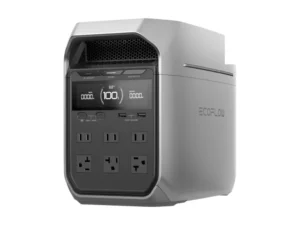
EcoFlow
DELTA 3 Plus
- Capacity1,024 Wh LFP
- AC output (120 V)1,800 W (3,600 W surge)
- Outage switchoverUPS, under 10 ms
Best for: Fast switchover (under 10 ms), 56-minute wall recharge, 1,000 W of solar input and expansion to 5 kWh.
Check Price on Amazon for EcoFlow DELTA 3 Plus (opens Amazon in a new tab)Specs from each model's U.S. manual or official datasheet. Full comparison in the table below. As an Amazon Associate we earn from qualifying purchases.
| Model | Capacity | AC output (120 V) | Outage switchover | AC charging input | Solar input | Weight | Price |
|---|---|---|---|---|---|---|---|
| EcoFlow DELTA 3 Plus | 1,024 Wh LFP | 1,800 W (3,600 W surge) | UPS, under 10 ms | 1,500 W (100% in 56 min) | 2 × 500 W, 11–60 V | 27.6 lb | Check Price for EcoFlow DELTA 3 Plus (opens Amazon in a new tab) |
Source: EcoFlow DELTA 3 Plus U.S. Specs table, read November 19, 2026. X-Boost runs resistive loads such as heaters and kettles up to 2,200 W. The 56-minute figure is EcoFlow’s claim under its own test conditions.
The port list is generous for the class: six AC outlets, two USB-C ports (140 W max), two USB-A ports (36 W max), a 12.6 V/10 A car outlet and two DC5521 ports, for 13 outputs in total. The battery pack carries an IP65 rating, and EcoFlow lists noise under 30 dB at 600 W.
At about 16 × 8 × 11 inches and 27.6 lb, it’s a short carry rather than a backpack load. That’s heavier than the lightest 1 kWh station we’ve compared, the 23.8 lb Jackery Explorer 1000 v2, but lighter than the 35.3 lb BLUETTI AC180 we compare it with below.
Runtime at 120 V
This runtime table answers the main question in any EcoFlow DELTA 3 Plus review: how long it runs the things you care about. We treat 85% of rated capacity as usable, run AC loads through an 85%-efficient inverter and add an assumed 10 W of idle draw, since EcoFlow publishes no idle figure.
| Load (example, on AC) | Runtime |
|---|---|
| Wi-Fi router and modem, 20 W | 26.0 h |
| CPAP with humidifier and heated tube, 34 W | 17.4 h (about 2 nights of 8 hours) |
| Refrigerator, 600 kWh/yr label (about 68.5 W average) | 9.6 h |
| TV and streaming box, 100 W | 6.8 h |
| Microwave drawing 1,500 W from the outlet | About 29 min |
Formula: hours = rated Wh × 0.85 ÷ (load W ÷ 0.85 + 10 W). The CPAP figure is ResMed’s published average for an AirSense 10 with humidifier and heated tube (doc. 1018673/1). For CPAP use, check your device manual and talk to your doctor or equipment supplier before relying on battery power.
For a refrigerator, the DELTA 3 Plus covers an overnight outage but not a full day. Its 1,800 W continuous rating clears the roughly 1,200 W starting figure Honda lists for an Energy Star refrigerator, so the startup spike isn’t a problem; capacity is the limit. Our refrigerator guide has the full compressor math.
Charging: Wall, Solar and Car
Fast refilling is where this station stands out in our EcoFlow DELTA 3 Plus review. EcoFlow lists 1,500 W of AC charging and a full charge in 56 minutes, so a short return of grid power or a brief generator run refills it before the next outage. That speed matters most with rolling or repeated outages.
Solar input is the other strength. Two separate inputs each accept 11–60 V at up to 500 W, for 1,000 W combined, which lets you split panels into two smaller arrays. With 1,000 W of full-rated sun, the math says about an hour to refill 1,024 Wh before conversion losses, though real panels deliver less than their rating; check your string in our Voc & MPPT compatibility checker.
In a vehicle, EcoFlow lists 800 W of car charging in about 1.3 hours, but only with its separately sold 800 W Alternator Charger. Without that accessory, check the manual for car-charging limits before counting on a vehicle as a recharge path.
Expansion, Switchover and Safety
Expansion sets the DELTA 3 Plus apart from several 1 kWh stations we’ve compared, a point this EcoFlow DELTA 3 Plus review weighs heavily: it’s a 1 kWh station that can grow. EcoFlow’s U.S. page lists 1–5 kWh of capacity with a DELTA 3, DELTA 2, DELTA 2 Max or DELTA Pro 3 Extra Battery connected through the Alternator Charger’s XT150 output cable. Among the other 1 kWh models in our guides, only the DELTA 2 (up to 3 kWh) and the original Anker SOLIX C1000 also list expansion; the C1000 Gen 2 does not.
Its UPS switches a plugged-in load to battery in under 10 ms, tied with the Anker SOLIX C1000 Gen 2 for the fastest figure among the 1 kWh stations we’ve compared. That makes it a strong choice to sit between the wall and a desktop PC, NAS or network gear, devices that can reboot during a slower switchover.
The LFP battery is rated for 4,000 cycles to 80% capacity, and EcoFlow backs it with a 5-year warranty. Those two numbers support the long ownership period a backup battery needs, especially for buyers who plan to cycle it daily with solar.
Value and Price
For the value line of this EcoFlow DELTA 3 Plus review, we used the official store price: EcoFlow’s U.S. store listed the DELTA 3 Plus at $719 on November 19, 2026, about $0.70 per rated watt-hour. The BLUETTI AC180 was $549 the same day, about $0.48 per watt-hour, so the DELTA 3 Plus costs roughly $170 more for slightly less capacity.
What that premium buys is speed: a faster switchover (under 10 ms vs. 20 ms or less on the AC180), twice the solar input and a faster wall recharge. If your plan is an evening outage with wall charging only, the cheaper station does the same job; if you’ll run sensitive electronics or charge from the sun, the extra cost is easier to justify.
EcoFlow DELTA 3 Plus Review Verdict: Who Should Buy It and Who Should Skip It
This EcoFlow DELTA 3 Plus review comes down to how you’ll use the station. Its strengths are speed and flexibility, and its weakness is cost per watt-hour, so the right buyer is someone who will actually use the fast switchover, the solar input or the expansion path.
Who should buy it: households that want a 1 kWh backup for a desktop PC, network gear or a CPAP (for CPAP use, check your device manual and talk to your doctor or equipment supplier first) with a fast switchover, solar users who want 1,000 W of input, and anyone who wants the option to add an extra battery later instead of buying a second station.
Who should skip it: buyers who only want the most watt-hours per dollar for evening outages, owners of a working DELTA 2 (same 1,024 Wh, see our DELTA 2 vs DELTA 3 Plus breakdown), and anyone who needs a full day of refrigerator backup without recharging.
Alternatives to Consider
If price per watt-hour matters most, the BLUETTI AC180 offers 1,152 Wh for less money with a slower switchover. If you want a faster wall recharge and a lighter body, see our Anker SOLIX C1000 Gen 2 review: a 49-minute UltraFast recharge, 24.9 lb and a 10 ms UPS. Our DELTA 3 Plus vs Anker SOLIX C1000 head-to-head covers the original, expandable C1000.
For a full refrigerator day, step up to the 2 kWh class: our EcoFlow DELTA 2 Max review and 2000Wh power station comparison cover the options. Check current prices in the model card above.
Frequently Asked Questions
Yes, if you value speed: a switchover under 10 ms, 1,000 W of solar input and a 56-minute wall recharge. It scores 8.8/10 on our spec rubric. If you only need evening backup at the lowest cost per watt-hour, a cheaper 1 kWh station does the same job.
About 9.6 hours for a refrigerator with a 600 kWh/year EnergyGuide label, under our assumptions of 85% usable capacity, an 85%-efficient inverter and 10 W of idle draw. Its 1,800 W rating covers a typical compressor start.
EcoFlow lists 1,500 W of AC charging for a full charge in 56 minutes, and 1,000 W of solar input across two 500 W ports. Car charging at 800 W needs EcoFlow’s separately sold 800 W Alternator Charger.
Yes. EcoFlow’s U.S. page lists 1–5 kWh with a DELTA 3, DELTA 2, DELTA 2 Max or DELTA Pro 3 Extra Battery, connected through the Alternator Charger’s XT150 output cable.
Yes. At ResMed’s 34 W average for an AirSense 10 with humidifier and heated tube, it runs about 17.4 hours on AC, or about two 8-hour nights. Check your device manual and talk to your doctor or equipment supplier first.