Quick Verdict: Top Picks
- Best OverallEcoFlow DELTA 3 MaxAbout 19 hours on a 600 kWh/year fridge, a switchover under 10 ms and about 44.8 lb.Check Price for EcoFlow DELTA 3 Max (opens Amazon in a new tab)
- Best for Long OutagesEcoFlow DELTA 2 Max1,000 W of solar input and a 4 kWh extra-battery option for multi-day outages.Check Price for EcoFlow DELTA 2 Max (opens Amazon in a new tab)
- Best ValueBLUETTI AC180About 10 hours on a typical fridge: one night of backup at the lowest price per Wh in the 1 kWh class.Check Price for BLUETTI AC180 (opens Amazon in a new tab)
- Best Fast ChargingAnker SOLIX C1000 Gen 2Rolling outages: 1,600 W input refills it in about 49 minutes for another 9 to 10 hours of fridge time.Check Price for Anker SOLIX C1000 Gen 2 (opens Amazon in a new tab)
Picks are based on the manufacturer specs and the math in this guide. Prices change often, so check the current price on Amazon.
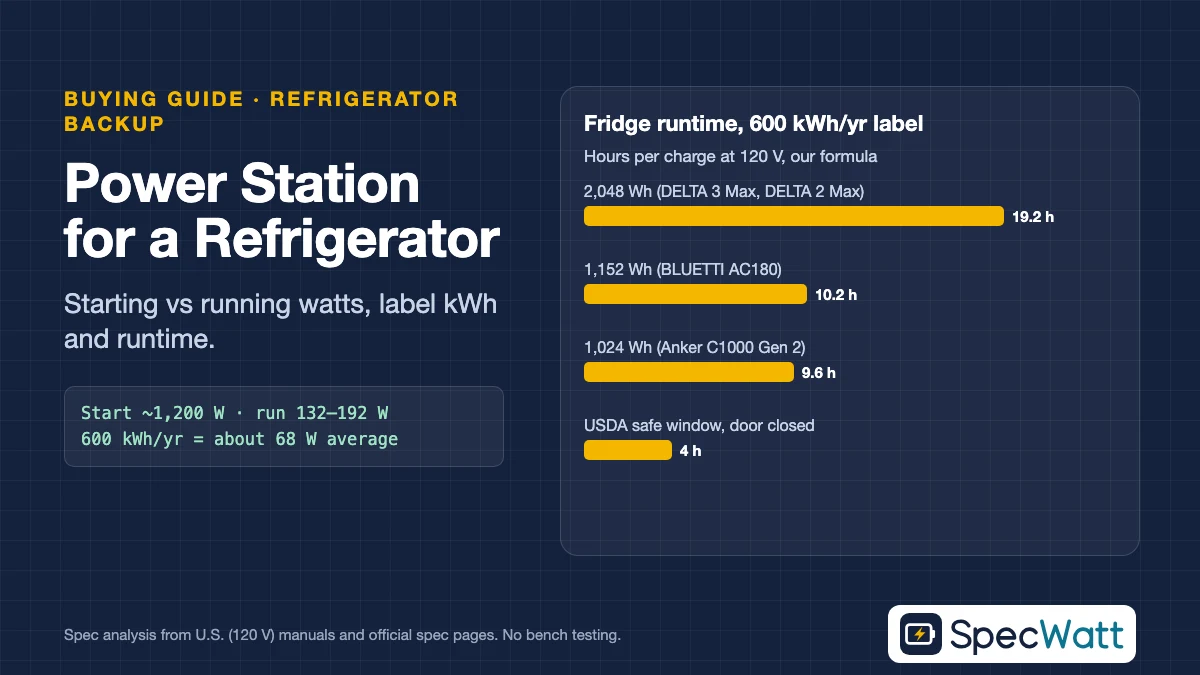
The best portable power station for refrigerator backup needs two things: an AC rating above your fridge’s startup spike and enough watt-hours to cover its average draw for the whole outage. For a refrigerator with a 600 kWh/year label, a 2,048 Wh portable power station for refrigerator backup such as the EcoFlow DELTA 3 Max runs it for about 19 hours, enough to bridge an overnight outage with room to spare.
USDA food-safety guidance gives you about 4 hours with the door shut before refrigerated food is at risk, so even a 1,000 Wh station adds roughly 10 hours to that window. This guide shows the compressor math first, then matches five stations to outage lengths using U.S. 120 V specs we read from each maker’s documents.
Our Top Picks: Award Criteria and Who Should Skip Each
Every award below is based on the specs in the comparison table, not on price alone. A portable power station for refrigerator use earns a pick when its continuous AC rating clears a fridge’s starting surge with margin and its usable capacity covers a realistic outage plan.
| Award | Pick | Why it wins | Who should skip it |
|---|---|---|---|
| Best Overall | EcoFlow DELTA 3 Max | 2,048 Wh, 2,400 W AC, under 10 ms UPS, about 44.8 lb | Solar-first users (500 W solar ceiling) |
| Best for Long Outages | EcoFlow DELTA 2 Max | 1,000 W of solar input and a 4 kWh extra-battery option | Anyone who wants the lightest 2 kWh station |
| Best Value | BLUETTI AC180 | 1,152 Wh for about 10 hours of fridge time | Outages longer than one night |
| Best Fast Charging | Anker SOLIX C1000 Gen 2 | 1,600 W input for 1,024 Wh, 100% in 49 minutes per Anker | Anyone who needs more than about 10 hours per charge |
Award criteria. Best Overall needs at least 2,000 Wh, a switchover under 20 ms and the lowest weight per watt-hour among the 2 kWh models. Best for Long Outages rewards the most solar input and expansion among models in stock at the maker’s U.S. store on November 19, 2026. Best Value is the lowest price per rated watt-hour in the 1,000 Wh class at list price on November 19, 2026, and Best Fast Charging is the highest AC charging input per watt-hour of capacity with a maker-published full-charge time (1.56 W per Wh for the C1000 Gen 2 vs. 0.88–1.25 for the others).
The BLUETTI AC200L appears in the comparison but carries no award: it has the most expansion and solar input of the five, but BLUETTI’s U.S. store showed it out of stock on November 19, 2026. If you find it in stock from a reputable seller, it’s a strong long-outage choice.
Comparison: Five Stations for a Refrigerator at 120 V
The table lists the specs that decide whether a portable power station for refrigerator backup will work: capacity, continuous and surge AC output at 120 V, switchover time, solar input and weight. BLUETTI’s Power Lifting figures apply to resistive loads only, so we label them Power Lifting rather than surge.
Models at a glance
EcoFlow
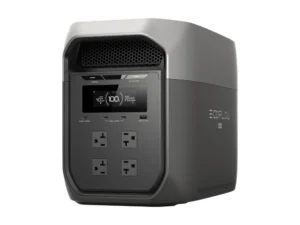
DELTA 3 Max
- Capacity2,048 Wh LFP
- AC output (120 V)2,400 W (4,800 W surge)
- Outage switchoverUPS, under 10 ms
Best for: About 19 hours on a 600 kWh/year fridge, a switchover under 10 ms and about 44.8 lb.
Check Price on Amazon for EcoFlow DELTA 3 Max (opens Amazon in a new tab)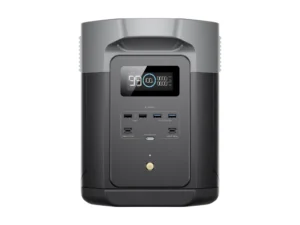
EcoFlow
DELTA 2 Max
- Capacity2,048 Wh LFP
- AC output (120 V)2,400 W (4,800 W surge)
- Outage switchoverEPS, 30 ms
Best for: 1,000 W of solar input and a 4 kWh extra-battery option for multi-day outages.
Check Price on Amazon for EcoFlow DELTA 2 Max (opens Amazon in a new tab)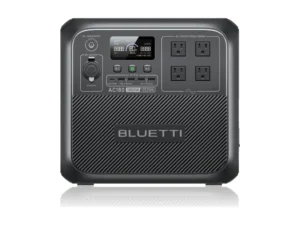
BLUETTI
AC180
- Capacity1,152 Wh LiFePO4
- AC output (120 V)1,800 W (2,700 W Power Lifting)
- Outage switchoverUPS, 20 ms or less
Best for: About 10 hours on a typical fridge: one night of backup at the lowest price per Wh in the 1 kWh class.
Check Price on Amazon for BLUETTI AC180 (opens Amazon in a new tab)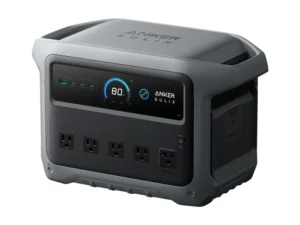
Anker SOLIX
C1000 Gen 2
- Capacity1,024 Wh
- AC output (120 V)2,000 W (3,000 W peak)
- Outage switchoverUPS, 10 ms
Best for: Rolling outages: 1,600 W input refills it in about 49 minutes for another 9 to 10 hours of fridge time.
Check Price on Amazon for Anker SOLIX C1000 Gen 2 (opens Amazon in a new tab)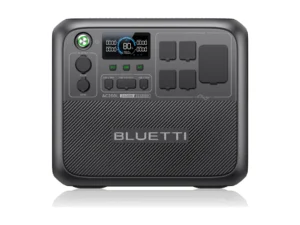
BLUETTI
AC200L
- Capacity2,048 Wh LiFePO4
- AC output (120 V)2,400 W (3,600 W Power Lifting)
- Outage switchoverUPS, 20 ms or less
Best for: Expandable to 8,192 Wh with 1,200 W of solar input, but out of stock at BLUETTI's U.S. store on Nov 19, 2026.
Check Price on Amazon for BLUETTI AC200L (opens Amazon in a new tab)Specs from each model's U.S. manual or official datasheet. Full comparison in the table below. As an Amazon Associate we earn from qualifying purchases.
| Model | Capacity | AC output (120 V) | Outage switchover | Solar input | AC charging input | Weight | Price |
|---|---|---|---|---|---|---|---|
| EcoFlow DELTA 3 Max | 2,048 Wh LFP | 2,400 W (4,800 W surge) | UPS, under 10 ms | 500 W max | 1,800 W | About 44.8 lb | Check Price for EcoFlow DELTA 3 Max (opens Amazon in a new tab) |
| EcoFlow DELTA 2 Max | 2,048 Wh LFP | 2,400 W (4,800 W surge) | EPS, 30 ms | 2 × 500 W, 11–60 V (1,000 W) | 1,800 W | About 50 lb | Check Price for EcoFlow DELTA 2 Max (opens Amazon in a new tab) |
| BLUETTI AC200L | 2,048 Wh LiFePO4 | 2,400 W (3,600 W Power Lifting) | UPS, 20 ms or less | 1,200 W, 12–145 V | 2,400 W Turbo | 62.4 lb | Check Price for BLUETTI AC200L (opens Amazon in a new tab) |
| BLUETTI AC180 | 1,152 Wh LiFePO4 | 1,800 W (2,700 W Power Lifting) | UPS, 20 ms or less | 500 W, 12–60 V | 1,440 W | 35.3 lb | Check Price for BLUETTI AC180 (opens Amazon in a new tab) |
| Anker SOLIX C1000 Gen 2 | 1,024 Wh | 2,000 W (3,000 W peak) | UPS, 10 ms | 600 W, 11–60 V | 1,600 W UltraFast | 24.9 lb | Check Price for Anker SOLIX C1000 Gen 2 (opens Amazon in a new tab) |
Sources: EcoFlow DELTA 3 Max U.S. spec page and DELTA 2 Max user manual (EFD350); BLUETTI AC200L user manual V3.0 and AC180 user manual (120 VAC); Anker SOLIX C1000 Gen 2 U.S. Specs tab. Specs checked November 19, 2026. The DELTA 3 Max’s U.S. page lists 500 W of solar input without voltage limits.
All five are rated for continuous AC output of at least 1,800 W, which is the number that matters most for a refrigerator: it covers the compressor’s startup spike with room left for a router, lights or a phone charger running at the same time.
For a portable power station for refrigerator use, the real split is capacity. The three 2,048 Wh models roughly double the fridge runtime of the two 1,000 Wh class models, at 10 to 38 lb more. Pick the smaller class only if your outages are short or you can recharge between them.
Compressor Math: Starting Watts vs Running Watts vs Average Draw
A refrigerator uses power in three ways, and each number answers a different sizing question. Honda’s generator wattage guide lists an Energy Star refrigerator or freezer at about 1,200 W of starting power and 132–192 W while the compressor runs. Those are planning figures; your model’s label or manual is the final word.
- Starting watts (about 1,200 W): a spike of a second or two when the compressor kicks on. It must stay under the station’s continuous AC rating, or its surge rating at the very least.
- Running watts (about 132–192 W): the draw while the compressor is on. Only this and anything else plugged in compete for the inverter.
- Average watts (label kWh ÷ 8,760 h): the compressor cycles on and off, so a 600 kWh/year fridge averages about 68 W. This is the number that sets runtime.
That last point is easy to get wrong. Dividing 68 W of average draw by roughly 150 W of running draw shows the compressor runs about 45% of the time; the rest of the hour it’s off. Sizing a portable power station for refrigerator use by running watts alone would overstate the energy you need by more than double.
The yellow EnergyGuide label on your refrigerator lists its estimated yearly use in kWh. Divide that number by 8,760 to get average watts, then enter it in our runtime calculator. Labels vary widely by size and age, so use the number on your own refrigerator rather than a typical figure.
Will It Start Your Fridge? Checking the Surge
The startup check is simple: the station’s continuous AC rating should exceed your fridge’s starting watts, and its surge rating gives extra margin. Every station in this guide is rated for at least 1,800 W continuous, so a refrigerator in the 1,200 W starting range sits well inside each rating.
Small stations are a different story. A unit rated at 800 W continuous with a 1,600 W surge, such as the EcoFlow RIVER 2 Pro, leaves little headroom for a 1,200 W start, and any second load can trip its overload protection. We don’t recommend a station below about 1,500 W continuous as a portable power station for refrigerator backup.
If you can’t find the starting figure, look for “LRA” (locked-rotor amps) on the compressor label and multiply by 120 V for a rough worst case of the instantaneous draw. Plug the fridge directly into the station rather than through a long extension cord, and start it with no other heavy loads running.
Runtime by Refrigerator Size at 120 V
This table turns four example EnergyGuide labels into hours of runtime for each capacity class. A portable power station for refrigerator backup should cover at least your typical outage length, ideally with a margin for the door being opened more often than usual.
| Refrigerator label (average draw) | 2,048 Wh (DELTA 3 Max, DELTA 2 Max, AC200L) | 1,152 Wh (AC180) | 1,024 Wh (C1000 Gen 2) |
|---|---|---|---|
| Example: 350 kWh/yr label (about 40 W) | 30.5 h | 15.8 h | 15.3 h |
| Example: 450 kWh/yr label (about 51 W) | 24.7 h | 13.0 h | 12.4 h |
| Example: 600 kWh/yr label (about 68.5 W) | 19.2 h | 10.2 h | 9.6 h |
| Example: 800 kWh/yr label (about 91 W) | 14.8 h | 8.0 h | 7.4 h |
| 600 kWh/yr fridge + Wi-Fi router (20 W) | 15.3 h | 8.2 h | 7.6 h |
Formula: hours = rated Wh × 0.85 ÷ (average load W ÷ 0.85 + idle W). We assume 85% usable capacity, an 85%-efficient inverter and 10 W of idle draw, except the AC180, where BLUETTI’s manual lists about 15 W. Average load = label kWh/year × 1,000 ÷ 8,760.
Two habits stretch your station’s runtime further. Keep the door closed, since each opening adds compressor run time, and unplug anything else that doesn’t need to run. Freezers hold temperature longer: USDA says a full freezer stays safe for up to 48 hours with the door closed.
For outages longer than a day, plan to recharge the station. Assuming four hours of full-rated sun, a 400 W solar array yields roughly 1,600 Wh at best, about three-quarters of the roughly 2,170 Wh a day a 600 kWh/year fridge draws from the battery under our formula, which is where the DELTA 2 Max’s 1,000 W solar input and the AC200L’s 1,200 W input pull ahead.
EcoFlow DELTA 3 Max: Best Overall
The DELTA 3 Max is our top portable power station for refrigerator backup in this guide because it pairs 2,048 Wh with a switchover under 10 ms at the lowest weight of the three 2 kWh models. EcoFlow’s U.S. page lists 2,400 W of AC output (4,800 W surge), 3,400 W X-Boost and 1,800 W wall charging to 80% in 68 minutes.
It runs a 600 kWh/year refrigerator for about 19 hours, or about 15 hours with a Wi-Fi router alongside. EcoFlow’s U.S. store listed it at $879 on November 19, 2026, about $0.43 per rated watt-hour. Its limits are a 500 W solar ceiling and no extra-battery port; expansion belongs to the separate DELTA 3 Max Plus.
Who should skip it: anyone planning to run a refrigerator for several days on solar, which favors the DELTA 2 Max or AC200L.
EcoFlow DELTA 2 Max: Best for Long Outages
The DELTA 2 Max has the same 2,048 Wh and 2,400 W AC rating as the DELTA 3 Max, plus what a multi-day outage needs: two solar inputs at 11–60 V and 15 A for 1,000 W combined, and support for a Smart Extra Battery. EcoFlow’s U.S. store sold it with that battery as a 4 kWh bundle on November 19, 2026.
At 4 kWh, the same 600 kWh/year refrigerator runs for about 38 hours, roughly a day and a half, before solar. The tradeoffs are a 30 ms EPS switchover and about 50 lb of weight. It was $1,029 on EcoFlow’s U.S. store on November 19, 2026; compare our DELTA 2 Max vs DELTA 3 Max breakdown if you’re torn between them.
Who should skip it: apartment dwellers without room for panels, and anyone running a desktop PC that can’t ride through a 30 ms gap.
BLUETTI AC180: Best Value
The AC180 is the budget portable power station for refrigerator backup through a single night. BLUETTI’s manual lists 1,152 Wh of LiFePO4, 1,800 W of AC output (2,700 W Power Lifting for resistive loads), a UPS of 20 ms or less and 1,440 W wall charging, and it runs a 600 kWh/year fridge for about 10 hours.
BLUETTI’s U.S. store listed it at $549 on November 19, 2026, about $0.48 per rated watt-hour, the lowest in the 1,000 Wh class here; the C1000 Gen 2’s $699.99 list price works out to about $0.68. Its manual lists about 15 W of self-consumption, which we include in the runtime math; that’s higher than we assume for the others.
Who should skip it: households with frequent outages longer than 10 hours, and anyone who’ll also run a freezer.
Anker SOLIX C1000 Gen 2: Best Fast Charging
The C1000 Gen 2 suits rolling outages and generator owners. Anker’s U.S. Specs tab lists 1,024 Wh, 2,000 W of AC output (3,000 W peak), a 10 ms UPS and UltraFast charging at 1,600 W that reaches 100% in 49 minutes when enabled in the app; Anker says charging slows sharply below 68°F.
That speed means a short generator run, or a brief return of grid power, refills it for another 9 to 10 hours of fridge time. At 24.9 lb it’s also the easiest to move. It isn’t expandable, so the C1000 Gen 2 is a one-night unit unless you can recharge.
Who should skip it: anyone facing multi-day outages with no way to recharge; pick a 2 kWh model instead.
BLUETTI AC200L: Most Expansion, Out of Stock at BLUETTI
The AC200L has the strongest long-outage specs of the five on paper. Its U.S. manual (V3.0, 120 VAC) lists 2,048 Wh expandable to 8,192 Wh, 2,400 W of AC output, 1,200 W of solar input at 12–145 V and Turbo wall charging at 2,400 W. That high-voltage solar range lets you wire more panels in series.
We left it without an award because BLUETTI’s U.S. store showed it out of stock on November 19, 2026, after listing it at $899 the day before. Check availability and seller warranty terms before buying. Its 62.4 lb weight also makes it the hardest of the five to move.
Our Verdict
For most homes, the EcoFlow DELTA 3 Max is the best pick in this guide as a portable power station for refrigerator backup: about 19 hours on a 600 kWh/year fridge, a fast switchover and the lowest price per watt-hour of the 2 kWh models on November 19, 2026. Choose the DELTA 2 Max for multi-day outages with solar, or the AC180 to cover one night on a budget.
Check current prices in the model cards above. For a broader plan that adds a router, lights and a CPAP (check your CPAP’s manual and talk to your doctor or equipment supplier before relying on battery power), read our home backup guide, or compare the 2 kWh class in our 2000Wh power station comparison.
Frequently Asked Questions
Divide the kWh/year on the EnergyGuide label by 8,760 to get average watts. A 600 kWh/year fridge averages about 68 W, so a 2,048 Wh station runs it about 19 hours and a 1,024 Wh station about 9.6 hours under our assumptions.
Yes, if its continuous AC rating clears the fridge’s start. Honda lists about 1,200 W of starting power for an Energy Star refrigerator. A 1,000 Wh station with 1,800 W or more runs a 600 kWh/year fridge for roughly 9 to 10 hours.
Honda’s wattage guide lists about 1,200 W of starting power and 132–192 W of running power for an Energy Star refrigerator or freezer. Your model’s label or manual is the final word; “LRA” × 120 V gives a rough worst case.
USDA food-safety guidance says refrigerated food stays safe for about 4 hours if the door stays closed. A full freezer holds for up to 48 hours, or 24 hours if half full. A power station extends both windows.
Yes, on a 2 kWh station rated for 2,400 W, as long as both compressors’ combined starting and running loads stay under the AC rating. Runtime roughly halves, so add their label kWh together before you size the battery.