Quick Verdict: Top Picks
- Best OverallEcoFlow DELTA 3 PlusOutage backup and solar: a 10 ms switchover vs. under 20 ms, and 1,000 W of solar input vs. 600 W.Check Price for EcoFlow DELTA 3 Plus (opens Amazon in a new tab)
Picks are based on the manufacturer specs and the math in this guide. Prices change often, so check the current price on Amazon.
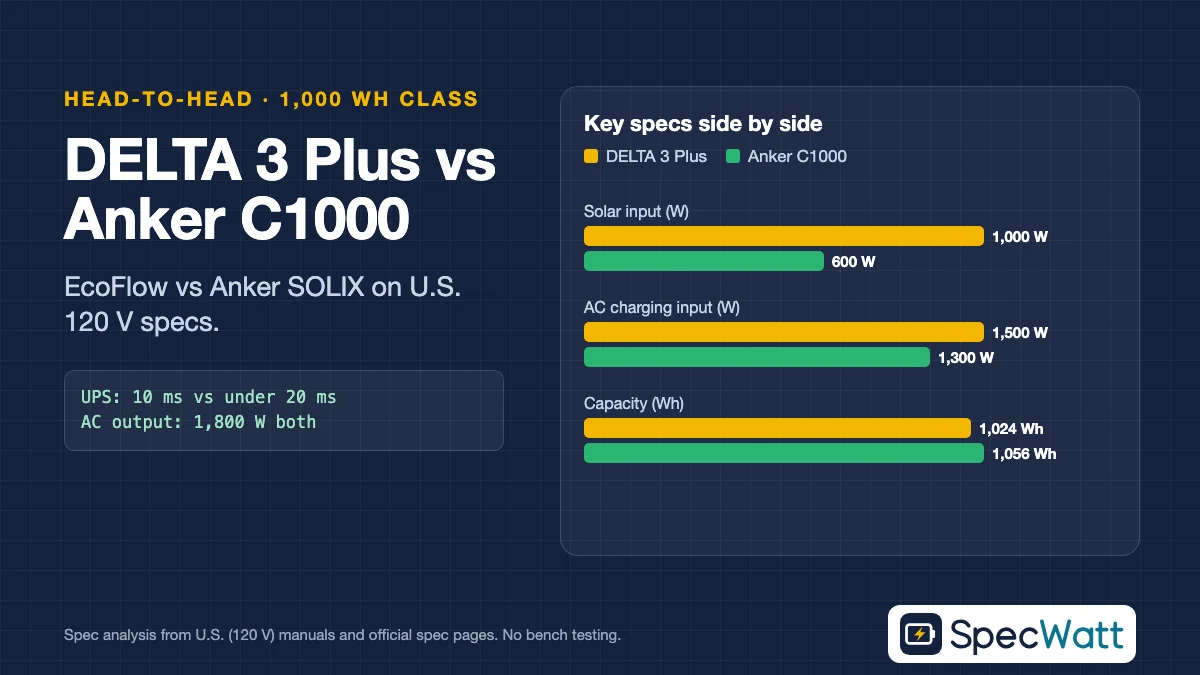
In the DELTA 3 Plus vs Anker SOLIX C1000 matchup, the EcoFlow DELTA 3 Plus is the better buy for most people: it switches over in 10 ms instead of under 20 ms, accepts 1,000 W of solar instead of 600 W and refills from the wall faster. The Anker SOLIX C1000 holds 32 Wh more and is the one to pick if you find it clearly cheaper, because the two deliver the same 1,800 W of continuous AC power.
Both are LiFePO4 stations in the same size class, so the DELTA 3 Plus vs Anker SOLIX C1000 decision comes down to backup speed, solar headroom and price on the day you buy. We took every number from the U.S. edition of each maker’s documentation and ran the same runtime formula our Power Station Runtime Calculator uses.
Category Winners: DELTA 3 Plus vs Anker SOLIX C1000 at a Glance
The table names a winner in each category and the published spec that decides it. Where a category can’t be settled from the makers’ own data, such as value without a same-day price for both, we say so instead of picking a side.
| Category | Winner | Deciding spec |
|---|---|---|
| Best Overall | EcoFlow DELTA 3 Plus | 10 ms switchover and 1,000 W solar input, both the better figure in this pair |
| Solar input | EcoFlow DELTA 3 Plus | 1,000 W across two inputs vs. 600 W on one |
| Best Value | No winner on Nov 18, 2026 | Anker’s U.S. store didn’t list the original C1000 that day, so we couldn’t compare prices |
| More capacity | Anker SOLIX C1000 | 1,056 Wh vs. 1,024 Wh, about 3% more |
| Who should skip the DELTA 3 Plus | Buyers focused on watt-hours per dollar | Highest price per rated Wh in its class among the models we priced (dated price below) |
| Who should skip the C1000 | Anyone running a desktop PC or network storage through outages | Its switchover is listed as under 20 ms, not 10 ms |
The DELTA 3 Plus wins the two categories that are hard to fix after purchase. Switchover speed decides whether a computer or router rides through a blackout, and solar input caps how fast you can refill during a long outage.
The C1000’s advantage is small but real: 32 Wh more capacity, which adds about 3% to every runtime below, from roughly 50 minutes on a router to about 15 minutes on a TV. Its single solar input also has a useful quirk, explained in the solar section.
Specs Side by Side
In this DELTA 3 Plus vs Anker SOLIX C1000 spec table, capacity is the rated battery size, AC output is the continuous rating at 120 V with the surge figure in parentheses, and switchover is the published time to move a plugged-in load from the wall to the battery.
Models at a glance
EcoFlow
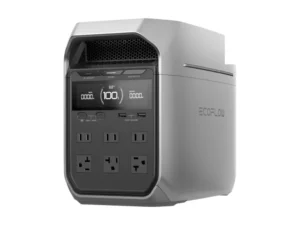
DELTA 3 Plus
- Capacity1,024 Wh LFP
- AC output (120 V)1,800 W (3,600 W surge)
- Solar input2 × 500 W, 11–60 V (1,000 W)
Best for: Outage backup and solar: a 10 ms switchover vs. under 20 ms, and 1,000 W of solar input vs. 600 W.
Check Price on Amazon for EcoFlow DELTA 3 Plus (opens Amazon in a new tab)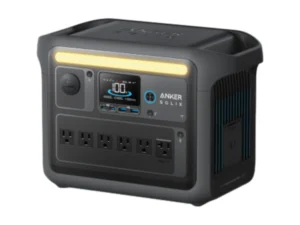
Anker SOLIX
C1000
- Capacity1,056 Wh LiFePO4
- AC output (120 V)1,800 W (2,400 W SurgePad)
- Solar input600 W, XT-60, 11–60 V
Best for: 32 Wh more capacity and the same 1,800 W of AC; buy it when it's clearly cheaper, and check the part number.
Check Price on Amazon for Anker SOLIX C1000 (opens Amazon in a new tab)Specs from each model's U.S. manual or official datasheet. Full comparison in the table below. As an Amazon Associate we earn from qualifying purchases.
| Model | Capacity | AC output (120 V) | Solar input | AC charging input | Outage switchover | Weight | Price |
|---|---|---|---|---|---|---|---|
| EcoFlow DELTA 3 Plus | 1,024 Wh LFP | 1,800 W (3,600 W surge) | 2 × 500 W, 11–60 V (1,000 W) | 1,500 W | 10 ms | 27.6 lb | Check Price for EcoFlow DELTA 3 Plus (opens Amazon in a new tab) |
| Anker SOLIX C1000 | 1,056 Wh LiFePO4 | 1,800 W (2,400 W SurgePad) | 600 W, XT-60, 11–60 V | 1,300 W max | Under 20 ms | 28.4 lb | Check Price for Anker SOLIX C1000 (opens Amazon in a new tab) |
Sources: EcoFlow U.S. DELTA 3 Plus spec page; Anker A1761 datasheet marked “Sales Market: US/CA.” EcoFlow lists 4,000 cycles to 80% and Anker 3,000+ cycles to 80%. Anker’s 2,400 W figure is its SurgePad rating. Specs checked November 18, 2026.
On paper the two are close on capacity, AC power and weight, separated by 32 Wh and 0.8 lb. The real gaps are in charging: EcoFlow lists a full AC recharge in 56 minutes at 1,500 W, while Anker’s datasheet lists about 90 minutes at its default 1,000 W, with up to 1,300 W available.
Both makers back these units with 5-year warranties, according to EcoFlow’s U.S. spec page and Anker’s datasheet. Both also include a 12 V car-style output, so a CPAP with its maker’s DC cable or a 12 V cooler can run without the inverter.
Runtime Compared at 120 V
We used the site’s standard formula: 85% of rated capacity is usable, and AC loads draw through an 85%-efficient inverter plus an assumed 10 W of idle draw. We didn’t find an idle figure in either maker’s U.S. documentation, so the assumption is the same for both.
| Load (example, on AC) | DELTA 3 Plus | Anker C1000 |
|---|---|---|
| Wi-Fi router and modem, 20 W | 26.0 h | 26.8 h |
| CPAP with humidifier and heated tube, 34 W | 17.4 h | 18.0 h |
| Refrigerator, 600 kWh/yr label (about 68 W average) | 9.6 h | 9.9 h |
| TV and streaming box, 100 W | 6.8 h | 7.0 h |
| Microwave drawing 1,500 W from the outlet | About 29 min | About 30 min |
Formula: hours = rated Wh × 0.85 ÷ (load W ÷ 0.85 + 10 W). The CPAP figure is ResMed’s published average for an AirSense 10 with humidifier and heated tube (doc. 1018673/1); the same document lists 7 W for the device alone and 22 W with the humidifier only. Use your own appliance labels in the runtime calculator.
On runtime, the Anker SOLIX C1000 runs every load about 3% longer, which is the whole capacity difference showing up. That’s under an hour on a router and under 20 minutes on a refrigerator, so it rarely changes the buying decision on its own.
Both handle a microwave drawing 1,500 W, since both are rated for 1,800 W continuous. Check your microwave’s input watts on its nameplate, because the cooking power printed on the front is lower than what it draws.
Solar Charging: The Biggest Difference
Solar is where the DELTA 3 Plus vs Anker SOLIX C1000 gap is widest. The DELTA 3 Plus accepts 500 W on each of two inputs at 11–60 V, 1,000 W in total. At the full rated input that’s enough to refill its 1,024 Wh battery in about an hour; real panels deliver less than their rating, so treat it as headroom for a growing array rather than a promise.
The C1000 takes 600 W on one XT-60 input, with a current limit that rises from 10 A at 11–32 V to 12.5 A at 32–60 V. That means two panels wired in series, which raises the voltage, use it better than one low-voltage panel. Below 32 V the 10 A limit caps the input at about 320 W, and the string’s cold-weather Voc must stay under 60 V. At its full 600 W, a refill takes about 1.8 hours of rated sun. Before you buy panels, run them through our Voc & MPPT compatibility checker.
Scenario Breakdown: Which One for Your Situation
Pick by the job you need the station to do, not by the logo. The table matches each common scenario in the DELTA 3 Plus vs Anker SOLIX C1000 decision to the better choice and the published spec behind it, so you can skip straight to your own use case.
| Scenario | Better pick | Why |
|---|---|---|
| Desktop PC, router or NAS through outages | DELTA 3 Plus | 10 ms switchover vs. under 20 ms |
| CPAP at home | Either | Both list an automatic switchover and run a 34 W CPAP for about 17–18 hours |
| Solar-first camping or van life | DELTA 3 Plus | 1,000 W of solar input vs. 600 W |
| Short, frequent outages | DELTA 3 Plus | 56-minute full AC recharge listed by EcoFlow |
| Most runtime from one battery | Anker SOLIX C1000 | 32 Wh more capacity |
| Lowest price per watt-hour | Check the day’s price | The original C1000 wasn’t priced on Anker’s U.S. store on Nov 18, 2026 |
For CPAP users, either station works on paper, but check your device manual and talk to your doctor or equipment supplier before relying on battery power. For the larger picture on outage sizing, see our home backup guide.
The table also shows why the DELTA 3 Plus vs Anker SOLIX C1000 decision is mostly about how you’ll recharge. If you’ll refill from the wall between outages and never add panels, the gap narrows to switchover speed and the price you find on the day.
EcoFlow DELTA 3 Plus: Who It’s For
The DELTA 3 Plus is the pick for home backup with sensitive electronics and for anyone building a solar setup. EcoFlow’s U.S. spec page lists 1,800 W of AC output (3,600 W surge), X-Boost up to 2,200 W for resistive loads, a 12.6 V/10 A car port, and an IP65 rating for the battery pack. EcoFlow’s U.S. store also lists expansion to 5 kWh with its extra batteries via an accessory cable.
It was $719 on EcoFlow’s U.S. store on November 18, 2026, about $0.70 per rated watt-hour, which is high for the class: the BLUETTI AC180 was $549 for 1,152 Wh (about $0.48 per Wh) the same day. You’re paying for the 10 ms switchover, the fast recharge and the 1,000 W of solar input.
Who should skip it: buyers who mainly want the most watt-hours per dollar, and anyone who will never use solar or rely on automatic switchover.
Anker SOLIX C1000: Who It’s For
The C1000 suits buyers who want 1,000 Wh-class capacity, 1,800 W of AC output and a published UPS at a lower price, when they can find one. Anker’s datasheet lists 1,056 Wh of LiFePO4 rated for 3,000+ cycles to 80%, a UPS switchover under 20 ms and a 5-year warranty.
Availability is the catch. On November 18, 2026, Anker’s U.S. store listed the C1000X (part number A1761111, filed by retailers under the same A1761 model) and the newer C1000 Gen 2 rather than the original C1000. We haven’t verified the Gen 2’s specs here, so confirm the part number on any listing before you compare it with this table.
Who should skip it: anyone whose computer or network gear needs the fastest published switchover, and solar users who plan to grow past 600 W.
Our Verdict
For most buyers, the DELTA 3 Plus vs Anker SOLIX C1000 choice goes to the DELTA 3 Plus, because its two advantages, a 10 ms switchover and 1,000 W of solar input, are the ones you can’t add later. The C1000 is a sound alternative when it’s clearly cheaper, since it matches the EcoFlow on continuous AC output and carries slightly more capacity.
If neither fits, compare them with the BLUETTI AC180 and Jackery Explorer 1000 v2 in our 1000Wh comparison, or read the brand-level view in EcoFlow vs Jackery vs BLUETTI vs Anker SOLIX.
Frequently Asked Questions
For most buyers, the DELTA 3 Plus. It lists a 10 ms switchover vs. under 20 ms, 1,000 W of solar input vs. 600 W, and a faster AC recharge. The C1000 has 32 Wh more capacity and the same 1,800 W of continuous AC output.
The Anker SOLIX C1000, with 1,056 Wh vs. 1,024 Wh. That’s about 3% more, which adds roughly 50 minutes to a 20 W router’s runtime and about 20 minutes to a refrigerator’s under our assumptions.
Yes. A refrigerator rated 600 kWh per year averages about 68 W, and both run it for about 10 hours: 9.6 hours on the DELTA 3 Plus and 9.9 hours on the C1000, using 85% usable capacity and an assumed 10 W of inverter idle draw.
Both list an automatic switchover: 10 ms for the DELTA 3 Plus and under 20 ms for the C1000. Neither is a zero-millisecond online UPS, so don’t rely on one alone for servers or life-support equipment.
The DELTA 3 Plus. It accepts 1,000 W across two inputs, enough on paper to refill in about an hour, while the C1000 accepts 600 W on one input, about 1.8 hours at full rated input. Real panels deliver less than their rating.