Quick Verdict: Top Picks
- Spec Score 7.3/10BLUETTI AC180The most battery per dollar among the 1 kWh stations we've compared: 1,152 Wh LiFePO4 with a 5-year warranty.Check Price for BLUETTI AC180 (opens Amazon in a new tab)
Picks are based on the manufacturer specs and the math in this guide. Prices change often, so check the current price on Amazon.
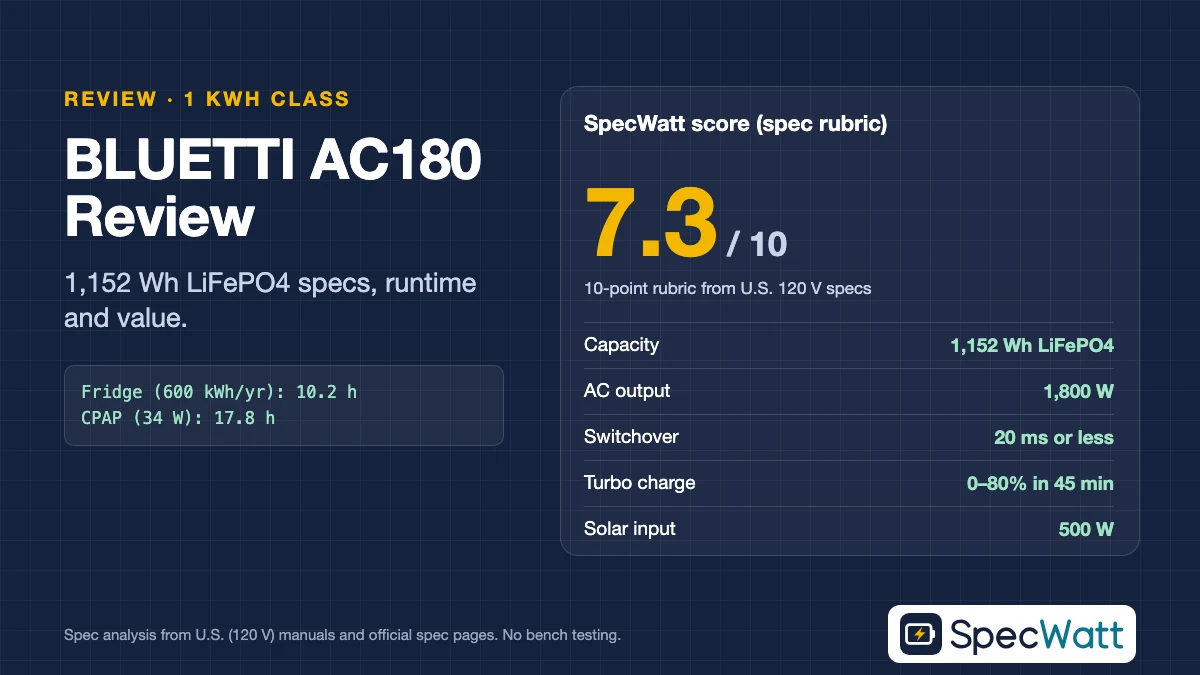
Our BLUETTI AC180 review gives it 7.3 out of 10, and most of those points come from value. At $549 on BLUETTI’s U.S. store on November 19, 2026, it offered 1,152 Wh of LiFePO4 for about $0.48 per watt-hour, the lowest figure among the 1,000–1,152 Wh stations we’ve compared that day (the larger 1,440 Wh AC180P was about $0.45). It gives up some speed for that price: a 500 W solar ceiling and a switchover of 20 ms or less.
This is a spec-sheet review, not a bench test. Every number comes from the Tech Specs tab on BLUETTI’s U.S. product page or the AC180 user manual (multi-region, 120 VAC section), and every runtime uses the open formula from our runtime calculator. The score follows the same 10-point rubric we apply to every station.
Our Score: 7.3 out of 10
The table breaks this BLUETTI AC180 review score into its ten rubric lines. Each line rests on a published spec, so you can see where the AC180 earns its points and where it falls behind faster, pricier stations in the same class.
| Rubric line (max points) | Score | Spec behind it |
|---|---|---|
| Capacity (1) | 0.5 | 1,152 Wh, the 1 kWh class |
| AC output (1) | 1 | 1,800 W continuous, 2,700 W surge |
| Wall charging (1) | 0.5 | Full in about 1.3–1.8 h at 1,440 W Turbo |
| Solar input (1) | 0.5 | 500 W, 12–60 V, 10 A |
| Outage switchover (1) | 0.75 | UPS, 20 ms or less |
| Portability (1) | 0.75 | About 33 Wh per lb (35.3 lb) |
| Chemistry and cycles (1) | 0.75 | LiFePO4, 3,500+ cycles |
| Warranty (1) | 1 | 5 years |
| Value (1.5) | 1.5 | Official-store price per Wh (price and date in the text) |
| Expansion (0.5) | 0 | No extra-battery option listed |
| Total | 7.25 → 7.3 |
The AC180’s full value score is what keeps it competitive. It drops points on speed (charging, solar and switchover), on weight per watt-hour and on expansion, which BLUETTI doesn’t list for this model. For buyers whose main goal is the most battery per dollar, those trade-offs may not matter.
BLUETTI AC180 Specs at 120 V
These are the specs from BLUETTI’s U.S. Tech Specs tab that matter for backup and camping. BLUETTI lists both a surge figure and a Power Lifting mode at 2,700 W; Power Lifting is only for heating (resistive) loads such as space heaters, so it isn’t a continuous rating.
Models at a glance
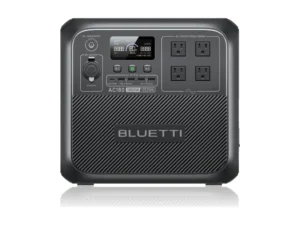
BLUETTI
AC180
- Capacity1,152 Wh LiFePO4
- AC output (120 V)1,800 W (2,700 W surge)
- Outage switchoverUPS, 20 ms or less
Best for: The most battery per dollar among the 1 kWh stations we've compared: 1,152 Wh LiFePO4 with a 5-year warranty.
Check Price on Amazon for BLUETTI AC180 (opens Amazon in a new tab)Specs from each model's U.S. manual or official datasheet. Full comparison in the table below. As an Amazon Associate we earn from qualifying purchases.
| Model | Capacity | AC output (120 V) | Outage switchover | AC charging input | Solar input | Weight | Price |
|---|---|---|---|---|---|---|---|
| BLUETTI AC180 | 1,152 Wh LiFePO4 | 1,800 W (2,700 W surge) | UPS, 20 ms or less | 1,440 W Turbo (0–80% in 45 min) | 500 W, 12–60 V, 10 A | 35.3 lb | Check Price for BLUETTI AC180 (opens Amazon in a new tab) |
Sources: BLUETTI AC180 U.S. Tech Specs tab, read November 19, 2026; AC180 user manual (multi-region, 120 VAC section) for the switchover time and the roughly 15 W self-consumption. The 45-minute figure is BLUETTI’s claim for 0–80%; it lists about 1.3–1.8 hours for a full Turbo charge.
The AC180 has four 120 V/15 A AC outlets, one 100 W USB-C port, four USB-A ports, a regulated 12 V/10 A car outlet and a 15 W wireless charging pad. That pad is handy for phones during an outage, though it adds to the station’s own power draw while in use.
At 13.4 × 9.7 × 12.5 inches and 35.3 lb, the AC180 is the heaviest 1 kWh station with a published weight that we’ve compared. That’s about 11.5 lb more than the Jackery Explorer 1000 v2 and 7.7 lb more than the EcoFlow DELTA 3 Plus, which matters if you’ll carry it to a campsite rather than keep it in a closet.
Runtime at 120 V
This runtime table is the practical heart of our BLUETTI AC180 review. We treat 85% of rated capacity as usable and run AC loads through an 85%-efficient inverter, and we use about 15 W of idle draw because BLUETTI’s manual lists roughly 15 W of self-consumption for the AC180.
| Load (example, on AC) | Runtime |
|---|---|
| Wi-Fi router and modem, 20 W | 25.4 h |
| CPAP with humidifier and heated tube, 34 W | 17.8 h (about 2 nights of 8 hours) |
| Refrigerator, 600 kWh/yr label (about 68.5 W average) | 10.2 h |
| TV and streaming box, 100 W | 7.4 h |
| Microwave drawing 1,500 W from the outlet | About 33 min |
Formula: hours = rated Wh × 0.85 ÷ (load W ÷ 0.85 + 15 W). The CPAP figure is ResMed’s published average for an AirSense 10 with humidifier and heated tube (doc. 1018673/1). For CPAP use, check your device manual and talk to your doctor or equipment supplier before relying on battery power.
The 15 W idle figure costs the AC180 most on small loads: its router runtime trails a 1,024 Wh station that we assume idles at 10 W. On larger loads its extra 128 Wh wins, which is why it runs a refrigerator longer than the 1,024 Wh stations we’ve compared. Its 1,800 W rating also covers the roughly 1,200 W Honda lists for an Energy Star refrigerator’s start.
Charging: Wall, Solar and Car
Wall charging has two modes. Standard mode draws up to 1,000 W, and Turbo mode draws 1,440 W for 0–80% in 45 minutes per BLUETTI, with a full charge in about 1.3–1.8 hours. That’s slower than the fastest 1 kWh stations we’ve compared (the DELTA 3 Plus lists 56 minutes) but quick enough to refill overnight or during a short return of grid power.
The solar input is the AC180’s main limitation in this BLUETTI AC180 review. It accepts 12–60 V at up to 10 A and 500 W, and BLUETTI lists about 2.8–3.3 hours for a full solar charge in ideal sun. That’s half the solar input of stations with 1,000 W of total solar input, so heavy solar users should look elsewhere; check your panel string in our Voc & MPPT compatibility checker.
It also charges from a 12/24 V car outlet, and BLUETTI lists a 1,440 W maximum input. Car charging is slow by nature, so treat it as a way to top up on a road trip rather than a full recharge plan.
Switchover, Battery and Warranty
The AC180’s UPS switches to battery in 20 ms or less, per its manual. That keeps most appliances and lights running through an outage; if you rely on a CPAP, check your device manual and talk to your doctor or equipment supplier before counting on any UPS. Also, a desktop PC or NAS has less margin than it would on a 10 ms station. If a device must not reboot, check its power-supply hold-up time before relying on any UPS.
BLUETTI lists LiFePO4 cells rated for more than 3,500 cycles and a 5-year warranty on its U.S. page. That cycle count is below the 4,000 cycles to 80% that EcoFlow and Anker publish for their latest 1 kWh stations, but it still supports years of regular use, and the warranty matches the longest among the stations we’ve compared.
Value and Price
For the value line, this BLUETTI AC180 review uses the official store price. BLUETTI’s U.S. store listed the AC180 at $549 on November 19, 2026, in stock, which is about $0.48 per rated watt-hour. The EcoFlow DELTA 3 Plus was $719 the same day, about $0.70 per watt-hour, for 128 Wh less.
That gap is the case for the AC180. You give up switchover speed, solar input, expansion and some weight, and you get more battery for roughly $170 less. For evening outages, a CPAP for a couple of nights (for CPAP use, check your device manual and talk to your doctor or equipment supplier first) or a weekend campsite, those trade-offs are reasonable.
BLUETTI AC180 Review Verdict: Who Should Buy It and Who Should Skip It
This BLUETTI AC180 review comes down to priorities. If cost per watt-hour leads your list, it’s a strong pick; if speed, solar or expansion matter more, a pricier 1 kWh station will serve you better over time.
Who should buy it: budget-minded buyers who want about 10 hours of refrigerator backup or two CPAP nights (for CPAP use, check your device manual and talk to your doctor or equipment supplier first), campers who recharge from the wall or a car between trips, and anyone who values a 5-year warranty and LiFePO4 at the lowest price per watt-hour among the 1 kWh stations we’ve compared (Nov 19, 2026).
Who should skip it: solar-first users who need more than 500 W of input, owners of desktop PCs or NAS units who want the shortest switchover, and anyone who wants to add capacity later.
Alternatives to Consider
If this BLUETTI AC180 review leaves you wanting faster everything, compare our EcoFlow DELTA 3 Plus review, which scores 8.8/10 for its 10 ms UPS and 1,000 W solar input at a higher price. If weight matters, our BLUETTI AC180 vs Jackery Explorer 1000 v2 head-to-head covers a lighter rival.
For more 1 kWh options, see our 1000Wh comparison, or our best portable power station under $500 guide if the budget is tighter. Check current prices in the model card above.
Frequently Asked Questions
Yes, if value comes first. It offered 1,152 Wh of LiFePO4 for about $0.48 per watt-hour on November 19, 2026, with a 5-year warranty. It scores 7.3/10 on our spec rubric because of its 500 W solar limit, 20 ms switchover and lack of expansion.
About 10.2 hours for a refrigerator with a 600 kWh/year EnergyGuide label, under our assumptions of 85% usable capacity, an 85%-efficient inverter and the roughly 15 W of self-consumption BLUETTI’s manual lists.
BLUETTI lists 0–80% in 45 minutes and a full charge in about 1.3–1.8 hours in Turbo mode at 1,440 W. Standard mode draws up to 1,000 W. From 500 W of solar, BLUETTI lists about 2.8–3.3 hours in ideal sun.
BLUETTI’s U.S. page for the AC180 lists no extra-battery option. If you think you’ll need more than about 1 kWh later, a station with an expansion port, or the 1,440 Wh AC180P, is the better starting point.
Yes. At ResMed’s 34 W average for an AirSense 10 with humidifier and heated tube, it runs about 17.8 hours on AC, roughly two 8-hour nights. Check your device manual and talk to your doctor or equipment supplier first.