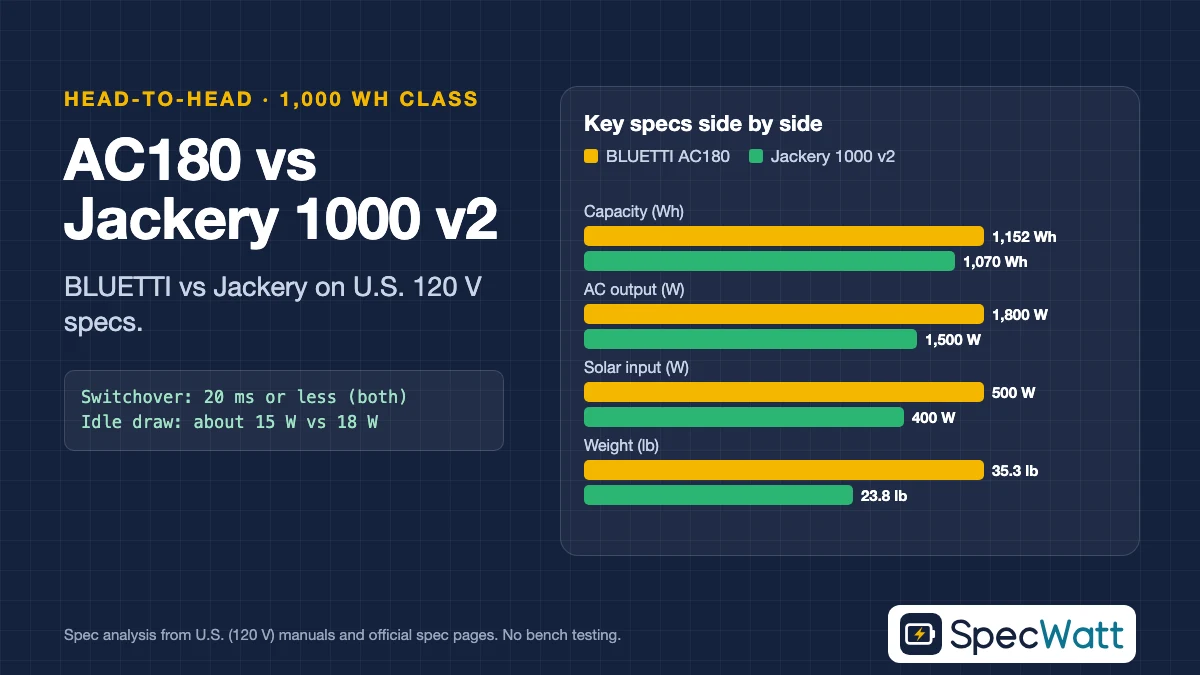
Quick Verdict: Top Picks
- Best OverallBLUETTI AC180More capacity (1,152 Wh), AC power (1,800 W) and solar input (500 W), at about $0.48 per Wh on Nov 18, 2026.Check Price for BLUETTI AC180 (opens Amazon in a new tab)
- Most PortableJackery Explorer 1000 v211.5 lb lighter at 23.8 lb, about 45 Wh per pound.Check Price for Jackery Explorer 1000 v2 (opens Amazon in a new tab)
Picks are based on the manufacturer specs and the math in this guide. Prices change often, so check the current price on Amazon.
In the AC180 vs Jackery 1000 v2 matchup, the BLUETTI AC180 wins on almost every spec: it has more capacity (1,152 Wh vs. 1,070 Wh), more continuous AC power (1,800 W vs. 1,500 W), more solar input (500 W vs. 400 W) and, on November 18, 2026, a lower price per watt-hour. The Jackery Explorer 1000 v2 wins on one thing that matters a lot to campers: it’s 11.5 lb lighter.
So the AC180 vs Jackery 1000 v2 decision comes down to whether the station stays home or travels. We took every number from the U.S. edition of each maker’s documentation, ran the same runtime formula our Power Station Runtime Calculator uses, and corrected it for the idle draw each maker publishes.
Category Winners: AC180 vs Jackery 1000 v2 at a Glance
The table names a winner in each category of the AC180 vs Jackery 1000 v2 comparison and the published spec that decides it. Prices behind the value row come from the makers’ U.S. stores on November 18, 2026 and are quoted in the text below; every spec comes from the documents listed under the next table.
| Category | Winner | Deciding spec |
|---|---|---|
| Best Overall | BLUETTI AC180 | More capacity, AC power and solar input, at a lower price per Wh |
| Best for Solar | BLUETTI AC180 | 500 W at 12–60 V vs. 400 W combined across two inputs |
| Lower price per Wh | BLUETTI AC180 | More rated Wh for a lower store price on November 18, 2026 (prices in the model sections below) |
| Most Portable | Jackery Explorer 1000 v2 | 23.8 lb vs. 35.3 lb, about 45 Wh per pound vs. 33 |
| Who should skip the AC180 | Hikers and tent campers who carry gear by hand | At 35.3 lb, it’s 11.5 lb heavier than the Jackery |
| Who should skip the 1000 v2 | Anyone who runs 1,500 W appliances often or plans a big solar array | Its AC limit is 1,500 W and its solar input stops at 400 W |
The AC180 takes three of the four categories above, and it also recharges faster from the wall (1,440 W vs. about 1,000 W). The Jackery’s single win, weight, is the reason it still makes sense for a lot of buyers: carrying 35 lb from a car to a campsite is a different experience from carrying 24 lb.
Both stations publish a switchover of 20 ms or less, so neither has an edge for home backup on that line. The AC180’s manual lists 20 ms or less, and Jackery’s U.S. spec page lists 20 ms for the 1000 v2.
Specs Side by Side
In the AC180 vs Jackery 1000 v2 specs below, capacity is the rated battery size, AC output is the continuous rating at 120 V with the peak figure in parentheses, and switchover is the published time to move a plugged-in load from the wall to the battery.
Models at a glance
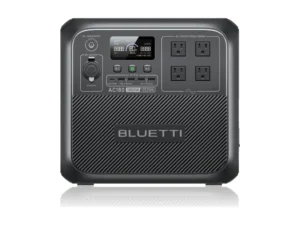
BLUETTI
AC180
- Capacity1,152 Wh LiFePO4
- AC output (120 V)1,800 W (2,700 W surge)
- Solar input500 W, DC7909, 12–60 V, 10 A
Best for: More capacity (1,152 Wh), AC power (1,800 W) and solar input (500 W), at about $0.48 per Wh on Nov 18, 2026.
Check Price on Amazon for BLUETTI AC180 (opens Amazon in a new tab)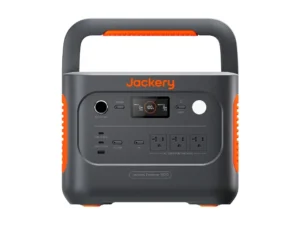
Jackery
Explorer 1000 v2
- Capacity1,070 Wh LiFePO4
- AC output (120 V)1,500 W (3,000 W peak)
- Solar input2 × 200 W, DC8020 (400 W), 16–60 V
Best for: 11.5 lb lighter at 23.8 lb, about 45 Wh per pound.
Check Price on Amazon for Jackery Explorer 1000 v2 (opens Amazon in a new tab)Specs from each model's U.S. manual or official datasheet. Full comparison in the table below. As an Amazon Associate we earn from qualifying purchases.
| Model | Capacity | AC output (120 V) | Solar input | AC charging input | Outage switchover | Weight | Price |
|---|---|---|---|---|---|---|---|
| BLUETTI AC180 | 1,152 Wh LiFePO4 | 1,800 W (2,700 W surge) | 500 W, DC7909, 12–60 V, 10 A | 1,440 W | 20 ms or less | 35.3 lb (16 kg) | Check Price for BLUETTI AC180 (opens Amazon in a new tab) |
| Jackery Explorer 1000 v2 | 1,070 Wh LiFePO4 | 1,500 W (3,000 W peak) | 2 × 200 W, DC8020 (400 W), 16–60 V | About 1,000 W | 20 ms | 23.8 lb (10.8 kg) | Check Price for Jackery Explorer 1000 v2 (opens Amazon in a new tab) |
Sources: BLUETTI AC180 user manual (120 VAC edition); Jackery U.S. specification page for the JE-1000D. BLUETTI’s 2,700 W Power Lifting mode applies to resistive loads such as kettles, not motors. Jackery lists 4,000 cycles to 70% and an AC recharge of about 1.7 hours. Specs checked November 18, 2026.
The Jackery’s 3,000 W instantaneous peak looks bigger than the AC180’s 2,700 W surge, but both are short starting reserves, not running ratings. BLUETTI’s separate Power Lifting mode (up to 2,700 W) works only with resistive loads and runs them at reduced power, so neither station runs a 2,000 W appliance at full power continuously.
Warranties differ too. Jackery lists 3 years for the 1000 v2, extendable by 2 years to 5. BLUETTI’s UK/EU warranty table lists 60 months for the AC180, but we couldn’t confirm the U.S. term, so check it with the seller.
Runtime Compared at 120 V
On runtime, the AC180 vs Jackery 1000 v2 gap favors the AC180 at every load, from about 3.5 extra hours on a router to a few minutes on a coffee maker. Both makers publish an idle figure, so we used them: BLUETTI lists about 15 W of self-consumption for the AC180 and Jackery lists 18 W of standby draw for the 1000 v2. Usable energy is 85% of rated capacity and the inverter is 85% efficient, the same baseline as our calculator.
| Load (example, on AC) | BLUETTI AC180 | Jackery 1000 v2 |
|---|---|---|
| Wi-Fi router and modem, 20 W | 25.4 h | 21.9 h |
| CPAP with humidifier and heated tube, 34 W | 17.8 h | 15.7 h |
| Refrigerator, 600 kWh/yr label (about 68 W average) | 10.2 h | 9.2 h |
| TV and streaming box, 100 W | 7.4 h | 6.7 h |
| Coffee maker drawing 900 W | About 55 min | About 51 min |
Formula: hours = rated Wh × 0.85 ÷ (load W ÷ 0.85 + published idle W), with 15 W for the AC180 and 18 W for the 1000 v2. The CPAP figure is ResMed’s published average for an AirSense 10 with humidifier and heated tube (doc. 1018673/1).
The gap is widest at small loads, where idle draw is a bigger share of the total: the AC180 runs a router about 3.5 hours longer. At a refrigerator’s average draw, the difference shrinks to about an hour, and with a 900 W appliance it’s a few minutes.
The practical lesson applies to both: turn the AC output off when nothing needs it, and run 12 V gear from the car-style ports. That idle draw adds up to 360–430 Wh over a full day, a third or more of either battery’s usable energy.
Solar Charging Compared
The AC180 takes up to 500 W on one DC7909 input, at 12–60 V and 10 A. BLUETTI’s manual warns that a panel open-circuit voltage above 60 V can damage the unit, so two panels in series must stay under that limit in cold weather. At the full 500 W, a refill takes about 2.3 hours of rated sun.
The Jackery 1000 v2 has two DC8020 inputs at 200 W each, 400 W combined, with 10.5 A per port between 16 and 60 V. At the full 400 W, a refill takes about 2.7 hours of rated sun. Our solar panel connector guide shows which adapter each plug needs, and the Voc & MPPT compatibility checker tests a panel or series string against both limits.
Scenario Breakdown: Which One for Your Situation
Pick by the job you need the station to do, not by the brand. The table below sorts common jobs between the AC180 and the Jackery 1000 v2, with the published spec behind each pick.
| Scenario | Better pick | Why |
|---|---|---|
| Home backup for a router and lights | BLUETTI AC180 | About 3.5 more hours on a 20 W router |
| CPAP at home | Either, AC180 runs longer | Both list a 20 ms switchover; about 17.8 h vs. 15.7 h on a 34 W CPAP |
| Tent camping or hiking from the car | Jackery 1000 v2 | 11.5 lb lighter |
| Running a 1,500 W microwave | BLUETTI AC180 | 1,800 W rating leaves headroom; the Jackery is at its limit |
| Solar charging on longer trips | BLUETTI AC180 | 500 W vs. 400 W of input |
| Lowest price per Wh | BLUETTI AC180 | More Wh for less money at the Nov 18, 2026 store prices quoted below |
For CPAP use, check your device manual and talk to your doctor or equipment supplier before relying on battery power. For outage sizing beyond these two models, see our home backup guide.
Only one row goes to the Jackery, and it’s the one many campers care about most. If the station will live in a closet or an RV, the AC180 vs Jackery 1000 v2 choice is easy; if you’ll carry it often, weigh those 11.5 lb seriously.
BLUETTI AC180: Who It’s For
The AC180 suits home backup, RV use and anyone who wants the most capacity and AC power for the money in this class. Its manual lists 1,152 Wh of LiFePO4, 1,800 W of continuous AC output, up to 1,440 W of AC charging and a switchover of 20 ms or less, plus a 12 V/10 A car port for DC gear.
At $549 on BLUETTI’s U.S. store on November 18, 2026, it cost about $0.48 per rated watt-hour, the lower figure in this pair. Its weak points are weight, 35.3 lb, and a single solar input that stops at 500 W.
Who should skip it: anyone who carries gear by hand for more than a short walk, and solar users who want to grow past 500 W.
Jackery Explorer 1000 v2: Who It’s For
The Explorer 1000 v2 is the camping pick. Jackery’s U.S. spec page lists 1,070 Wh of LiFePO4 in 23.8 lb, about 45 Wh per pound, plus 1,500 W of AC output, a 20 ms switchover, two USB-C ports (100 W and 30 W) and a 12 V/10 A car port.
It was $559 on Jackery’s U.S. store on November 18, 2026, about $0.52 per rated watt-hour. Its limits are the 1,500 W AC ceiling, 400 W of solar input and 18 W of standby draw, which matters on long nights with small loads.
Who should skip it: anyone who runs 1,500 W appliances often, and solar-first users who plan to run more than 400 W of panels.
Our Verdict
For most buyers, the AC180 vs Jackery 1000 v2 choice goes to the BLUETTI AC180: more capacity, more AC power, more solar input and a lower price per watt-hour on November 18, 2026. Choose the Jackery Explorer 1000 v2 when portability comes first, since it delivers nearly the same energy in a package 11.5 lb lighter.
To see both next to the EcoFlow DELTA 3 Plus and Anker SOLIX C1000, read our 1000Wh comparison. For a camping-focused shortlist, see the camping and RV guide.
Frequently Asked Questions
The BLUETTI AC180, for most uses. It has more capacity (1,152 Wh vs. 1,070 Wh), more AC power (1,800 W vs. 1,500 W), more solar input (500 W vs. 400 W) and a lower price per Wh on Nov 18, 2026. The Jackery is 11.5 lb lighter.
The Jackery Explorer 1000 v2, at 23.8 lb vs. 35.3 lb for the AC180. That’s about 45 Wh per pound for the Jackery vs. about 33 Wh per pound for the BLUETTI.
About 10.2 hours on the AC180 and 9.2 hours on the Jackery for a refrigerator rated 600 kWh per year, using 85% usable capacity, 85% inverter efficiency and each maker’s published idle draw.
The AC180 can run one drawing up to 1,800 W continuously. The Jackery’s limit is 1,500 W, so a microwave drawing 1,500 W from the outlet sits right at its ceiling. Check the input watts on your microwave’s nameplate.
The AC180. It accepts 500 W on one input, about 2.3 hours to refill at full rated input, while the Jackery accepts 400 W across two inputs, about 2.7 hours. Real panels usually deliver less than their rating.