Quick Verdict: Top Picks
- Best for Home BackupEcoFlow DELTA 2 MaxA refrigerator plus essentials: about 14 hours on 2,048 Wh, with 2,400 W of AC output and an EPS switchover under 30 ms.Check Price for EcoFlow DELTA 2 Max (opens Amazon in a new tab)
- Best Fast ChargingEcoFlow DELTA 3 PlusShort, frequent outages: 1,500 W of AC charging (full in 56 minutes per EcoFlow) and the fastest UPS here at 10 ms.Check Price for EcoFlow DELTA 3 Plus (opens Amazon in a new tab)
- Best ValueBLUETTI AC180Essentials and a CPAP on a budget: about 23 hours of essentials and the lowest price per Wh of the 1,000 Wh models sold new on Nov 18, 2026 (about $0.48).Check Price for BLUETTI AC180 (opens Amazon in a new tab)
Picks are based on the manufacturer specs and the math in this guide. Prices change often, so check the current price on Amazon.
The best portable power station for home backup is the one whose usable watt-hours cover your outage plan, with an AC rating above your largest appliance and an automatic switchover for anything that can’t blink. For most homes that want a refrigerator plus essentials for about 14 hours, that means a 2,000 Wh unit such as the EcoFlow DELTA 2 Max. For a router, lights, phones and a CPAP, a 1,000 Wh unit is enough for a night.
This guide works backward from the appliances. We start with the wattage on each nameplate, turn it into a daily energy budget at 120 V, and then match that budget to six models whose specs we pulled from U.S. manuals and spec pages. Every runtime uses the same formula as our Power Station Runtime Calculator, so you can swap in your own numbers.
Quick Comparison: Which Power Station for Home Backup Fits Your Plan
The table lists what matters for a power station for home backup: capacity, the continuous AC rating at 120 V, how fast it switches over when the grid drops, and how quickly it refills. Surge or peak ratings are in parentheses; BLUETTI’s Power Lifting figure applies to resistive loads only.
Models at a glance
EcoFlow
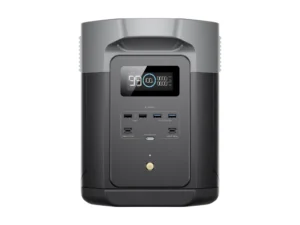
DELTA 2 Max
- Capacity2,048 Wh LFP
- AC output (120 V)2,400 W (4,800 W surge)
- Outage switchoverEPS, under 30 ms
Best for: A refrigerator plus essentials: about 14 hours on 2,048 Wh, with 2,400 W of AC output and an EPS switchover under 30 ms.
Check Price on Amazon for EcoFlow DELTA 2 Max (opens Amazon in a new tab)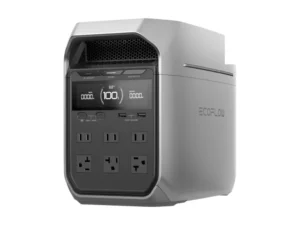
EcoFlow
DELTA 3 Plus
- Capacity1,024 Wh LFP
- AC output (120 V)1,800 W (3,600 W surge)
- Outage switchoverUPS, 10 ms
Best for: Short, frequent outages: 1,500 W of AC charging (full in 56 minutes per EcoFlow) and the fastest UPS here at 10 ms.
Check Price on Amazon for EcoFlow DELTA 3 Plus (opens Amazon in a new tab)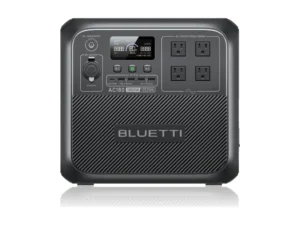
BLUETTI
AC180
- Capacity1,152 Wh LiFePO4
- AC output (120 V)1,800 W (2,700 W Power Lifting)
- Outage switchoverUPS, 20 ms or less
Best for: Essentials and a CPAP on a budget: about 23 hours of essentials and the lowest price per Wh of the 1,000 Wh models sold new on Nov 18, 2026 (about $0.48).
Check Price on Amazon for BLUETTI AC180 (opens Amazon in a new tab)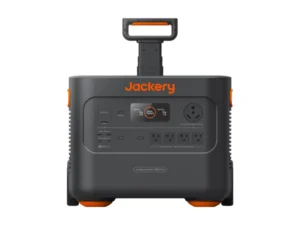
Jackery
Explorer 2000 Plus
- Capacity2,042.8 Wh lithium-ion
- AC output (120 V)3,000 W (6,000 W surge)
- Outage switchoverEPS, 20 ms
Best for: The highest AC rating here (3,000 W), but sold only refurbished on Jackery's U.S. store on Nov 18, 2026.
Check Price on Amazon for Jackery Explorer 2000 Plus (opens Amazon in a new tab)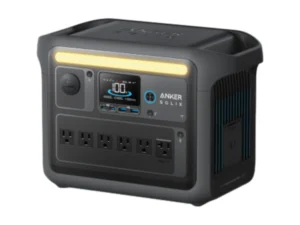
Anker SOLIX
C1000
- Capacity1,056 Wh LiFePO4
- AC output (120 V)1,800 W (2,400 W surge)
- Outage switchoverUPS, under 20 ms
Best for: A router, lights and a CPAP: about 21 hours of essentials, with a UPS switchover under 20 ms.
Check Price on Amazon for Anker SOLIX C1000 (opens Amazon in a new tab)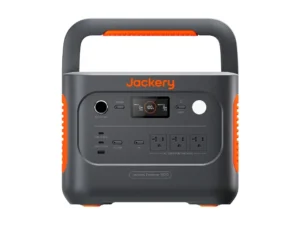
Jackery
Explorer 1000 v2
- Capacity1,070 Wh LiFePO4
- AC output (120 V)1,500 W (3,000 W peak)
- Outage switchoverUPS, 20 ms
Best for: Backup you can move easily: 23.8 lb, about 21 hours of essentials and a 20 ms UPS.
Check Price on Amazon for Jackery Explorer 1000 v2 (opens Amazon in a new tab)Specs from each model's U.S. manual or official datasheet. Full comparison in the table below. As an Amazon Associate we earn from qualifying purchases.
| Model | Capacity | AC output (120 V) | Outage switchover | Solar input | AC charging input | Weight | Price |
|---|---|---|---|---|---|---|---|
| EcoFlow DELTA 2 Max | 2,048 Wh LFP | 2,400 W (4,800 W surge) | EPS, under 30 ms | 2 × 500 W, 11–60 V (1,000 W) | 1,800 W | 50 lb | Check Price for EcoFlow DELTA 2 Max (opens Amazon in a new tab) |
| Jackery Explorer 2000 Plus | 2,042.8 Wh lithium-ion | 3,000 W (6,000 W surge) | EPS, 20 ms | 2 × DC8020, 1,400 W combined | 120 V, 15 A max | 61.5 lb | Check Price for Jackery Explorer 2000 Plus (opens Amazon in a new tab) |
| EcoFlow DELTA 3 Plus | 1,024 Wh LFP | 1,800 W (3,600 W surge) | UPS, 10 ms | 2 × 500 W, 11–60 V (1,000 W) | 1,500 W | 27.6 lb | Check Price for EcoFlow DELTA 3 Plus (opens Amazon in a new tab) |
| BLUETTI AC180 | 1,152 Wh LiFePO4 | 1,800 W (2,700 W Power Lifting) | UPS, 20 ms or less | 500 W, DC7909, 12–60 V | 1,440 W | 35.3 lb | Check Price for BLUETTI AC180 (opens Amazon in a new tab) |
| Anker SOLIX C1000 | 1,056 Wh LiFePO4 | 1,800 W (2,400 W surge) | UPS, under 20 ms | 600 W, XT-60, 11–60 V | 1,300 W max | 28.4 lb | Check Price for Anker SOLIX C1000 (opens Amazon in a new tab) |
| Jackery Explorer 1000 v2 | 1,070 Wh LiFePO4 | 1,500 W (3,000 W peak) | UPS, 20 ms | 2 × 200 W, DC8020 (400 W) | About 1,000 W | 23.8 lb | Check Price for Jackery Explorer 1000 v2 (opens Amazon in a new tab) |
Sources: EcoFlow DELTA 2 Max user manual and U.S. DELTA 3 Plus spec page; Jackery Explorer 2000 Plus manual (JE-2000C, 120 V) and U.S. JE-1000D specification page; BLUETTI AC180 user manual (120 VAC); Anker A1761 datasheet (Sales Market: US/CA). The 2000 Plus manual lists its cells as lithium-ion. Specs checked November 18, 2026.
The two 2,000 Wh models are in a different league for a refrigerator: they roughly double every runtime in this guide. The four 1,000 Wh models are lighter, cheaper and easier to store, and they handle a night of essentials or a CPAP without trouble.
One availability note before you shop. On November 18, 2026, Jackery’s U.S. store listed the Explorer 2000 Plus only as a refurbished unit, and its page pointed to the newer HomePower 2000 Plus v2. We haven’t verified the v2’s specs here, so the 2000 Plus stays in the table for comparison only.
Step 1: Add Up the Watts Your Power Station for Home Backup Must Cover
Every appliance lists its power on a label, usually as watts (W) or as volts and amps; multiply volts by amps to get watts. For anything with a compressor or motor, such as a refrigerator, the label rating is the running figure, and the brief startup spike is higher. Five of the six list a surge or peak rating of at least 2,400 W, which typically covers a household refrigerator’s start. BLUETTI describes the AC180’s 2,700 W figure as Power Lifting for resistive loads, so confirm its motor-start rating, and your refrigerator’s startup figure, before you count on it.
Two numbers matter when you size a power station for home backup. The first is the largest single load you’ll run at once, which must stay under the station’s continuous AC rating. The second is the energy each load uses over a day, which decides how many hours the battery lasts. A refrigerator is the classic example: its compressor cycles on and off, so its average draw is far below its running watts.
- Refrigerator: use the kWh/year on the yellow EnergyGuide label. 600 kWh/year ÷ 8,760 hours is about 68 W on average.
- Wi-Fi router and modem: about 20 W together is a reasonable planning figure; check the power adapters.
- LED bulbs: the watts printed on the bulb, often 9 W for a 60 W-equivalent bulb.
- CPAP: ResMed lists about 34 W for an AirSense 10 with humidifier and heated tube (doc. 1018673/1). Check your device manual and talk to your provider or equipment supplier before relying on battery power.
Our sizing calculators take this list and do the rest. For space heaters, electric kettles and other heating loads rated around 1,500 W, plan on running them only briefly: they empty a 1,000 Wh battery in well under an hour.
Step 2: Turn Watts into a Daily Energy Budget for a Power Outage
Every power station for home backup loses some energy in its inverter, so the battery supplies more than your appliances use. Our math uses three assumptions, the same ones the calculator uses: 85% of rated capacity is usable, the inverter is 85% efficient, and it draws 10 W of idle power whenever the AC output is on. The table turns four common outage plans into watt-hours per day and the hours each capacity class covers.
| Outage plan (example, all on AC) | Battery energy per day | 1,024 Wh (DELTA 3 Plus) | 1,152 Wh (AC180) | 2,048 Wh (DELTA 2 Max) |
|---|---|---|---|---|
| Essentials: router 24 h (20 W), three 9 W LED bulbs 5 h, phones and a laptop (60 Wh) | 1,034 Wh | 20 h | 23 h | 40 h |
| Refrigerator only (600 kWh/yr label) | 2,174 Wh | 9.6 h | 10.8 h | 19.2 h |
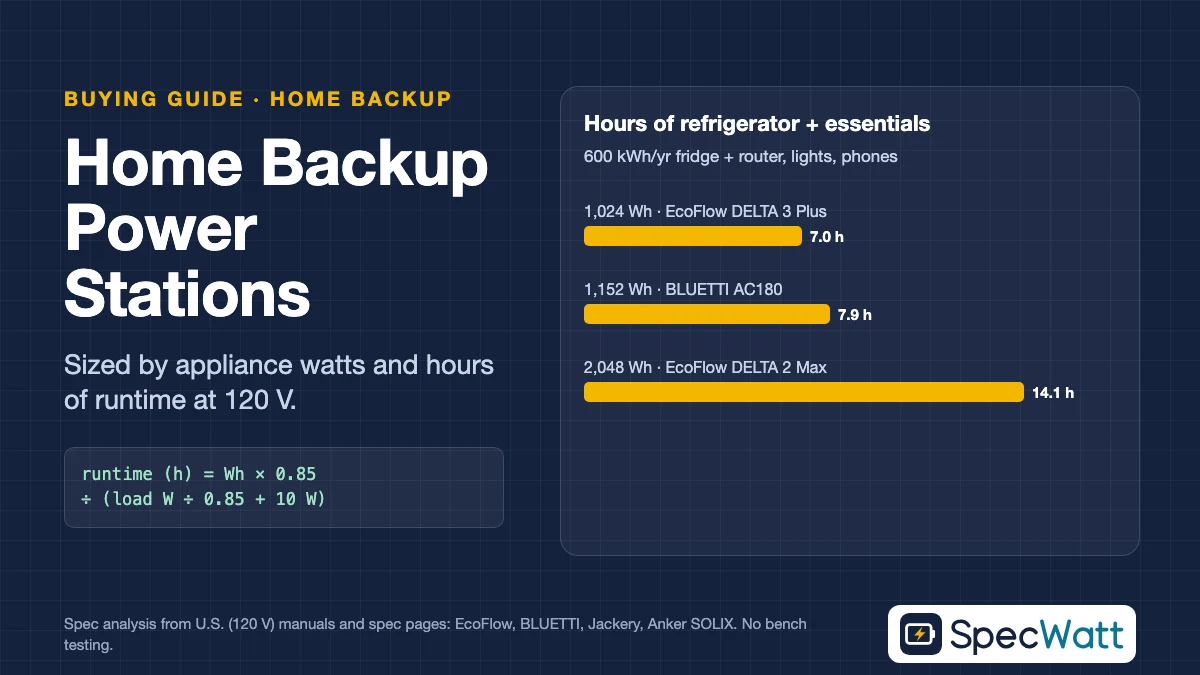
| Refrigerator + essentials | 2,968 Wh | 7.0 h | 7.9 h | 14.1 h |
| CPAP, one 8-hour night at 34 W | 400 Wh per night | 2.2 nights | 2.4 nights | 4.4 nights |
Formula: battery energy = outlet energy ÷ 0.85 + 10 W × hours with the AC output on; runtime = rated Wh × 0.85 ÷ battery energy. Example loads, not measurements; replace them with your own labels in the runtime calculator.
The refrigerator rows set the size of a power station for home backup. Even a 2,048 Wh unit keeps a 600 kWh/year refrigerator alone running for about 19 hours, and about 14 hours with essentials added, so a power outage longer than a day needs a recharge source: solar panels, a car or a generator.
Our assumed 10 W of inverter idle draw adds up to 240 Wh over 24 hours, more than a quarter (about 28%) of a 1,024 Wh battery’s usable energy. As a general rule, run DC-capable loads, such as a router with a 12 V adapter or a CPAP with a DC cable, from the DC ports to skip that loss.
Best for Home Backup: EcoFlow DELTA 2 Max
As a power station for home backup, the DELTA 2 Max has the most usable energy of the six models in this guide that were sold new on their makers’ U.S. stores on November 18, 2026 (the BLUETTI AC200L, covered in our DELTA 2 Max vs AC200L head-to-head, matches its 2,048 Wh): about 1,741 Wh of its 2,048 Wh rating, enough for a 600 kWh/year refrigerator plus essentials for about 14 hours. Its manual lists 2,400 W of continuous AC output (4,800 W surge), an EPS switchover under 30 ms and two solar inputs of 500 W each.
It also refills quickly from the wall with up to 1,800 W of AC input, and two 500 W solar inputs give it a path to recharge during a long outage. It was $1,029 on EcoFlow’s U.S. store that day, about $0.50 per rated watt-hour. The catch is size: at about 50 lb, it is a station you roll or carry a few steps, not one you take camping.
Who should skip it: apartments with only a router and phones to keep running, and anyone whose desktop PC or network storage must ride through a switchover without rebooting; its EPS is listed at under 30 ms, against 10 ms for the DELTA 3 Plus.
Best Fast Charging: EcoFlow DELTA 3 Plus
The DELTA 3 Plus earns Best Fast Charging because it has the shortest full AC recharge time published for any power station for home backup in this guide: 56 minutes on EcoFlow’s U.S. spec page, versus about 1.7 hours for the Explorer 1000 v2. That spec page lists 1,500 W of AC charging input, plus two solar inputs that accept 1,000 W in total. Its 10 ms UPS switchover is the fastest in this guide, which makes it the best fit here for a desktop computer or network gear that can’t tolerate a long gap.
Its 1,024 Wh battery covers essentials for about 20 hours or a CPAP for about two nights, but only about 9.6 hours of a 600 kWh/year refrigerator. At $719 on EcoFlow’s U.S. store on November 18, 2026, it cost about $0.70 per rated watt-hour, more than the AC180 (about $0.48) or the Explorer 1000 v2 ($559, about $0.52).
Who should skip it: households that want a refrigerator running through the night; a 2,000 Wh model does that job better.
Best Value: BLUETTI AC180
The AC180 had the lowest price per rated watt-hour among the 1,000 Wh models sold new on their makers’ U.S. stores: $549 on BLUETTI’s U.S. store on November 18, 2026, or about $0.48 per rated watt-hour. It also has the largest battery in that class at 1,152 Wh, 1,800 W of continuous AC output and a switchover of 20 ms or less, according to its manual.
Used as a power station for home backup, that buys about 23 hours of essentials, almost 11 hours of a 600 kWh/year refrigerator or about 2.4 CPAP nights. The manual lists about 15 W of self-consumption with the inverter on, so its overnight figures for small loads are slightly lower than the formula above suggests. It weighs 35.3 lb.
Who should skip it: buyers who want fast solar recharging, since its single input stops at 500 W.
Also Worth Considering
The Anker SOLIX C1000 (1,056 Wh, 1,800 W, UPS under 20 ms, 600 W solar) is a close match for the AC180 on paper. On November 18, 2026, Anker’s U.S. store listed the C1000X (A1761111) and the C1000 Gen 2 rather than the original C1000, so check the part number on any listing.
The Jackery Explorer 1000 v2 (1,070 Wh, 1,500 W, 20 ms) is the lightest backup option at 23.8 lb. Jackery lists 18 W of standby draw, so turn the AC output off between uses during a long outage. The Jackery Explorer 2000 Plus has the highest AC rating here, 3,000 W continuous, but was sold only refurbished on Jackery’s U.S. store when we checked.
How to Connect a Power Station for Home Backup Safely
Plug appliances directly into the power station or use a properly rated extension cord. Never plug a power station into a wall outlet to “backfeed” the house: it can energize the utility line, which puts line workers at risk, and it bypasses your home’s protection.
Whole-circuit backup needs a transfer switch or an inlet with an interlock, installed by a licensed electrician to your local code. Some makers sell transfer switches for their larger models; check that the one you choose is listed for your exact power station before you buy it.
Recharging During a Long Outage
A power station for home backup only lasts as long as its last charge, so plan the refill before you need it. Solar is the quietest option: our solar charging calculator estimates recharge time from your panel wattage and sun hours, and the solar panels for portable power stations guide covers matching panels to each input.
Check the solar input limits in the table before you buy panels. A station’s maximum watts, voltage window and current limit all have to fit the panel’s numbers, and the Voc & MPPT compatibility checker runs that check for you. If you’re comparing the 1,000 Wh models in more depth, see our 1000Wh portable power station comparison.
Our Pick for Most Homes
For a power station for home backup that keeps a refrigerator and essentials running, the EcoFlow DELTA 2 Max is our pick: it has the most usable energy of the models in this guide sold new on November 18, 2026 (about 1,741 Wh), which covers a 600 kWh/year refrigerator plus essentials for about 14 hours. If your outages are short and frequent, the DELTA 3 Plus refills fastest (56 minutes listed) and switches over in 10 ms.
If the budget is tight and your plan is essentials or a CPAP, the BLUETTI AC180 had the lowest price per rated watt-hour among those 1,000 Wh models that day. Whichever you choose, check its price and part number before you buy, and size it with your own appliance labels in the runtime calculator.
Frequently Asked Questions
Add up the watt-hours your appliances use per day. For a router, lights and phones, about 1,000 Wh covers roughly 20 hours. To keep a 600 kWh/year refrigerator plus essentials running for most of a day, plan on 2,000 Wh or more and a way to recharge.
Yes. A 600 kWh/year refrigerator averages about 68 W, and five of the six models here list a surge rating of 2,400 W or more (the AC180 lists Power Lifting, for resistive loads). A 1,024 Wh unit runs it for about 9.6 hours and a 2,048 Wh unit for about 19 hours, using our assumptions.
It powers selected appliances, not a whole house. With a refrigerator and essentials drawing about 2,968 Wh per day from the battery, a 2,048 Wh station lasts about 14 hours. Central air, electric heat and well pumps need far more power than portable units provide.
A power station is silent, has no exhaust and can run indoors, but it stores a limited amount of energy. A fuel generator runs as long as it has fuel but must stay outdoors, away from windows, because of carbon monoxide. Many households pair a station with solar panels or a generator.
No. Backfeeding a home through an outlet is dangerous and can energize the utility line. Plug appliances into the station directly, or have a licensed electrician install a transfer switch or an inlet with an interlock.