Quick Verdict: Top Picks
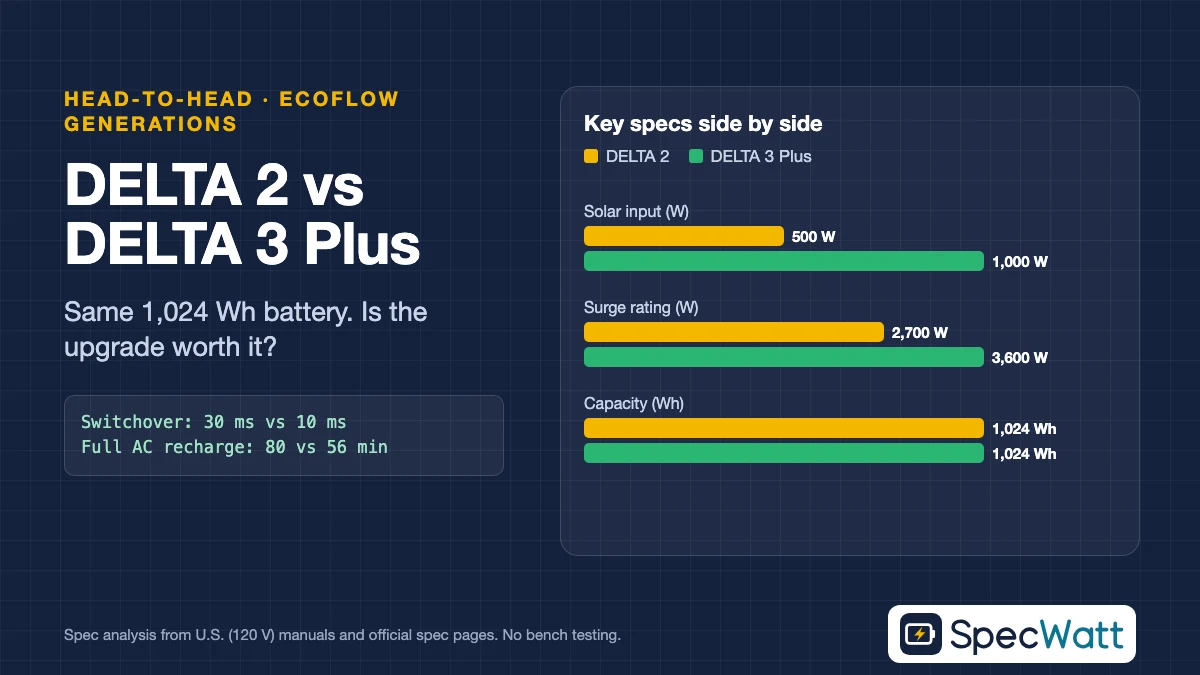
- Best OverallEcoFlow DELTA 3 PlusSame 1,024 Wh, but a 10 ms switchover vs. 30 ms and 1,000 W of solar input vs. 500 W.Check Price for EcoFlow DELTA 3 Plus (opens Amazon in a new tab)
Picks are based on the manufacturer specs and the math in this guide. Prices change often, so check the current price on Amazon.
In the DELTA 2 vs DELTA 3 Plus comparison, the DELTA 3 Plus is the better power station: it switches over in 10 ms instead of 30 ms, accepts twice the solar input (1,000 W vs. 500 W) and refills from the wall faster. The DELTA 2 is still worth buying only at a clear discount, because both hold the same 1,024 Wh and deliver the same 1,800 W of continuous AC power.
There’s also an availability twist. On November 18, 2026, EcoFlow’s U.S. store redirected the DELTA 2 product page to the DELTA 3, and EcoFlow’s official DELTA 2 page sent buyers to Amazon instead. We compared both models using EcoFlow’s own U.S. spec pages.
Category Winners: DELTA 2 vs DELTA 3 Plus at a Glance
The table names a winner in each category of the DELTA 2 vs DELTA 3 Plus comparison and the EcoFlow spec that decides it. Where a category depends on a price we couldn’t collect from EcoFlow’s own store, we say so rather than guess.
| Category | Winner | Deciding spec |
|---|---|---|
| Best Overall | EcoFlow DELTA 3 Plus | 10 ms vs. 30 ms switchover and 1,000 W vs. 500 W of solar input |
| Best for Solar | EcoFlow DELTA 3 Plus | Two 500 W inputs vs. up to 500 W total |
| Best Value | Depends on the listing price | Same capacity and AC rating; the DELTA 2 wasn’t sold new on EcoFlow’s U.S. store on Nov 18, 2026 |
| Fastest recharge | EcoFlow DELTA 3 Plus | 56 minutes listed vs. 80 minutes for a full AC charge |
| Who should skip the DELTA 3 Plus | Owners of a working DELTA 2 | Same capacity and AC output; upgrade only for switchover or solar |
| Who should skip the DELTA 2 | Anyone powering a desktop PC through outages | 30 ms EPS switchover |
The DELTA 3 Plus wins every category that has a clear spec behind it. The DELTA 2’s only edges in EcoFlow’s tables are small: a 2,400 W X-Boost rating (vs. 2,200 W) and a listed weight about half a pound lower. That’s why its case rests almost entirely on the price you can find for it today.
That price has to be meaningfully lower to make sense. The DELTA 3 Plus cost $719 on EcoFlow’s U.S. store on November 18, 2026; a DELTA 2 offered at close to that figure gives you the same battery with slower charging and half the solar input.
Specs Side by Side
In this DELTA 2 vs DELTA 3 Plus spec table, capacity is the rated battery size, AC output is the continuous rating at 120 V with the surge figure in parentheses, and switchover is EcoFlow’s published time to move a plugged-in load from the wall to the battery.
Models at a glance
EcoFlow
DELTA 3 Plus
- Capacity1,024 Wh LFP
- AC output (120 V)1,800 W (3,600 W surge)
- Solar input2 × 500 W, 11–60 V (1,000 W)
Best for: Same 1,024 Wh, but a 10 ms switchover vs. 30 ms and 1,000 W of solar input vs. 500 W.
Check Price on Amazon for EcoFlow DELTA 3 Plus (opens Amazon in a new tab)
EcoFlow
DELTA 2
- Capacity1,024 Wh LFP
- AC output (120 V)1,800 W (2,700 W surge)
- Solar inputUp to 500 W
Best for: Same battery and AC output; worth it only at a clear discount. Not sold new on EcoFlow's U.S. store on Nov 18, 2026.
Check Price on Amazon for EcoFlow DELTA 2 (opens Amazon in a new tab)Specs from each model's U.S. manual or official datasheet. Full comparison in the table below. As an Amazon Associate we earn from qualifying purchases.
| Model | Capacity | AC output (120 V) | Solar input | Full AC recharge | Outage switchover | Weight | Price |
|---|---|---|---|---|---|---|---|
| EcoFlow DELTA 3 Plus | 1,024 Wh LFP | 1,800 W (3,600 W surge) | 2 × 500 W, 11–60 V (1,000 W) | 56 min (1,500 W input) | 10 ms | 27.6 lb | Check Price for EcoFlow DELTA 3 Plus (opens Amazon in a new tab) |
| EcoFlow DELTA 2 | 1,024 Wh LFP | 1,800 W (2,700 W surge) | Up to 500 W | 80 min | 30 ms (EPS) | About 27 lb | Check Price for EcoFlow DELTA 2 (opens Amazon in a new tab) |
Sources: EcoFlow U.S. DELTA 3 Plus spec page; the Specs tab of EcoFlow’s official U.S. DELTA 2 page, read November 18, 2026. The DELTA 2 page lists solar input as “up to 500W” but doesn’t list its voltage and current limits. Both list 4,000 cycles to 80%, a 12.6 V/10 A car port and a 5-year warranty.
On paper the two share their battery: 1,024 Wh of LFP rated for 4,000 cycles to 80%, the same 1,800 W of continuous AC output and almost the same weight. EcoFlow also lists X-Boost for both, 2,400 W on the DELTA 2’s Specs tab and 2,200 W on the DELTA 3 Plus, for resistive loads that can run at reduced power.
The differences are in the electronics. The DELTA 3 Plus has a higher surge rating (3,600 W vs. 2,700 W), switches over three times faster and accepts twice the solar input on two separate ports, which also lets you split panels into two smaller arrays.
Runtime Compared at 120 V
Because both hold 1,024 Wh, EcoFlow DELTA 3 Plus vs DELTA 2 runtimes are identical under our formula: 85% of rated capacity is usable, and AC loads draw through an 85%-efficient inverter plus an assumed 10 W of idle draw. EcoFlow doesn’t publish an idle figure for either model.
| Load (example, on AC) | DELTA 2 | DELTA 3 Plus |
|---|---|---|
| Wi-Fi router and modem, 20 W | 26.0 h | 26.0 h |
| CPAP with humidifier and heated tube, 34 W | 17.4 h | 17.4 h |
| Refrigerator, 600 kWh/yr label (about 68 W average) | 9.6 h | 9.6 h |
| TV and streaming box, 100 W | 6.8 h | 6.8 h |
| Microwave drawing 1,500 W from the outlet | About 29 min | About 29 min |
Formula: hours = rated Wh × 0.85 ÷ (load W ÷ 0.85 + 10 W). The CPAP figure is ResMed’s published average for an AirSense 10 with humidifier and heated tube (doc. 1018673/1). Use your own appliance labels in the runtime calculator.
Identical runtimes are the key to the DELTA 2 vs DELTA 3 Plus decision. If you only need a battery that lasts through an evening outage and you’ll recharge from the wall, the two are equivalent in practice, and the cheaper listing wins as long as its warranty is intact.
What the table can’t show is how fast each one gets back to full. With 1,000 W of solar input the DELTA 3 Plus can, on paper, refill in about an hour of full-rated sun, while the DELTA 2’s 500 W takes about two hours; real panels deliver less than their rating.
Scenario Breakdown: Which One for Your Situation
Pick by the job you need the station to do, not by which one is newer. The table matches common scenarios in the DELTA 2 vs DELTA 3 Plus decision to the better choice and the EcoFlow spec behind it.
| Scenario | Better pick | Why |
|---|---|---|
| Desktop PC, router or NAS through outages | DELTA 3 Plus | 10 ms vs. 30 ms switchover |
| CPAP at home | Either, DELTA 3 Plus switches faster | Same 17.4 h on a 34 W CPAP |
| Solar charging on long outages or trips | DELTA 3 Plus | 1,000 W vs. 500 W of input |
| Evening outages, wall recharge only | Whichever is cheaper | Same capacity and AC rating |
| Already own a DELTA 2 | Keep it | An upgrade adds speed and solar, not runtime |
For CPAP use, check your device manual and talk to your doctor or equipment supplier before relying on battery power. A 30 ms switchover is fine for most devices, but some computers and network storage reboot during gaps that long.
If you’re shopping today, keep in mind that the DELTA 2 wasn’t sold new on EcoFlow’s U.S. store on November 18, 2026. Check the seller, condition and warranty terms on any DELTA 2 listing before comparing its price with the DELTA 3 Plus.
EcoFlow DELTA 3 Plus: Who It’s For
In the DELTA 3 Plus vs DELTA 2 matchup, the DELTA 3 Plus is the pick for new buyers who want home backup with sensitive electronics or plan to charge from solar. EcoFlow’s U.S. spec page lists 1,800 W of AC output (3,600 W surge), a 10 ms UPS, 1,500 W of AC charging, two 500 W solar inputs at 11–60 V and an IP65 rating for the battery pack.
It was $719 on EcoFlow’s U.S. store on November 18, 2026, about $0.70 per rated watt-hour. That’s a premium for the 1,000 Wh class (the BLUETTI AC180 was about $0.48 per Wh the same day), and what it buys is switchover speed, a 56-minute wall recharge and solar headroom you can grow into.
Who should skip it: owners of a working DELTA 2, and buyers who only want the most watt-hours per dollar.
EcoFlow DELTA 2: Who It’s For
On the other side of the DELTA 2 vs DELTA 3 Plus choice, the DELTA 2 suits buyers who find one at a clear discount and mostly recharge from the wall. EcoFlow’s U.S. Specs tab lists 1,024 Wh of LFP rated for 4,000 cycles to 80%, 1,800 W of AC output (2,700 W surge), a 30 ms EPS switchover, about 27 lb and expansion with a DELTA 2 or DELTA Max extra battery.
Its limits are solar and switchover. The DELTA 2’s page lists solar input up to 500 W without the voltage and current limits (EcoFlow’s 400W Lightweight panel manual lists up to 60 V for the DELTA 2), so confirm them on your unit’s label or manual before buying panels, and run them through our Voc & MPPT compatibility checker.
Who should skip it: anyone whose desktop PC or network gear must ride through a switchover, and solar-first users.
Our Verdict
For a new purchase, the DELTA 2 vs DELTA 3 Plus choice goes to the DELTA 3 Plus: same battery and AC output, but a 10 ms switchover, twice the solar input and a faster recharge. The DELTA 2 only makes sense at a clear discount, and owners of a working DELTA 2 gain speed and solar headroom from an upgrade, not runtime.
Check current prices in the model cards above, and confirm the seller and warranty on any DELTA 2 listing. To compare the DELTA 3 Plus with other 1,000 Wh options, read our DELTA 3 Plus vs Anker SOLIX C1000 head-to-head or the 1000Wh comparison.
Frequently Asked Questions
The DELTA 3 Plus. Both hold 1,024 Wh and deliver 1,800 W of continuous AC, but the DELTA 3 Plus switches over in 10 ms vs. 30 ms, accepts 1,000 W of solar vs. 500 W and recharges from the wall in 56 minutes vs. 80, per EcoFlow’s U.S. specs.
Yes. EcoFlow lists 1,024 Wh of LFP for both, rated for 4,000 cycles to 80%. Under our formula, both run a 600 kWh/year refrigerator for about 9.6 hours and a 34 W CPAP for about 17.4 hours.
On November 18, 2026, EcoFlow’s U.S. store redirected the DELTA 2 product page to the DELTA 3, and EcoFlow’s official DELTA 2 page linked to Amazon. Check the seller, condition and warranty on any DELTA 2 listing.
Only if you need a faster switchover for a computer or more solar input. The DELTA 3 Plus adds no capacity or continuous AC power over the DELTA 2, so the runtime on any load stays the same.
Yes, if the microwave draws no more than 1,800 W from the outlet. A microwave sold as “1,000 W” (cooking power) usually lists a higher input wattage on its nameplate; at 1,500 W of input, either one runs it for about 29 minutes under our assumptions. Check the input watts on the nameplate.