Quick Verdict: Top Picks
- Best BudgetBLUETTI AC70The lowest price per Wh we found ($0.47 on Nov 18, 2026), with 1,000 W of AC, 500 W of solar and a 20 ms or faster switchover.Check Price for BLUETTI AC70 (opens Amazon in a new tab)
- Best LightweightEcoFlow RIVER 2 ProCarrying it: 17.2 lb for 768 Wh, 5.3 lb lighter than the AC70.Check Price for EcoFlow RIVER 2 Pro (opens Amazon in a new tab)
Picks are based on the manufacturer specs and the math in this guide. Prices change often, so check the current price on Amazon.
The best portable power station under $500 for most buyers is the BLUETTI AC70: on November 18, 2026, it cost $359 on BLUETTI’s U.S. store for 768 Wh of LiFePO4, 1,000 W of AC output, 500 W of solar input and an automatic switchover of 20 ms or less. The EcoFlow RIVER 2 Pro, at $369 the same day, is the one to carry: it weighs 17.2 lb, 5.3 lb less than the AC70.
All three models here hold 768 Wh, so they run the same loads for almost exactly the same time. The differences are AC power, solar input, weight and switchover, and one availability problem with the Anker. We pulled every spec from U.S. manuals and datasheets and show the runtime math so you can check it against your own appliances.
Quick Comparison: Three 768Wh Picks for a Power Station Under $500
The table compares the specs that separate a good power station under $500 from a frustrating one. Capacity is identical, so look at the AC rating first: it caps the largest appliance you can plug in.
Models at a glance
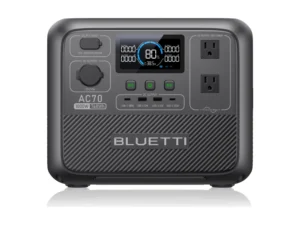
BLUETTI
AC70
- Capacity768 Wh LiFePO4
- AC output (120 V)1,000 W (2,000 W Power Lifting, resistive loads)
- Solar input500 W, XT60, 12–58 V, 10 A
Best for: The lowest price per Wh we found ($0.47 on Nov 18, 2026), with 1,000 W of AC, 500 W of solar and a 20 ms or faster switchover.
Check Price on Amazon for BLUETTI AC70 (opens Amazon in a new tab)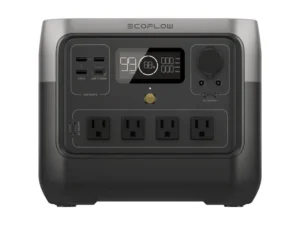
EcoFlow
RIVER 2 Pro
- Capacity768 Wh LFP
- AC output (120 V)800 W (1,600 W surge)
- Solar input220 W, XT60, 11–50 V, 13 A
Best for: Carrying it: 17.2 lb for 768 Wh, 5.3 lb lighter than the AC70.
Check Price on Amazon for EcoFlow RIVER 2 Pro (opens Amazon in a new tab)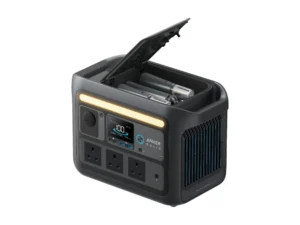
Anker SOLIX
C800X
- Capacity768 Wh LiFePO4
- AC output (120 V)1,200 W (1,920 W surge)
- Solar input300 W, XT-60, 11–60 V, 10 A
Best for: The highest AC rating of the three (1,200 W), but no longer listed on Anker's U.S. store on Nov 18, 2026.
Check Price on Amazon for Anker SOLIX C800X (opens Amazon in a new tab)Specs from each model's U.S. manual or official datasheet. Full comparison in the table below. As an Amazon Associate we earn from qualifying purchases.
| Model | Capacity | AC output (120 V) | Solar input | Weight | Outage switchover | AC charging | Price |
|---|---|---|---|---|---|---|---|
| BLUETTI AC70 | 768 Wh LiFePO4 | 1,000 W (2,000 W Power Lifting, resistive loads) | 500 W, XT60, 12–58 V, 10 A | 22.5 lb | 20 ms or less | Up to 850 W (Turbo) | Check Price for BLUETTI AC70 (opens Amazon in a new tab) |
| EcoFlow RIVER 2 Pro | 768 Wh LFP | 800 W (1,600 W surge) | 220 W, XT60, 11–50 V, 13 A | 17.2 lb | Not published | 940 W max | Check Price for EcoFlow RIVER 2 Pro (opens Amazon in a new tab) |
| Anker SOLIX C800X | 768 Wh LiFePO4 | 1,200 W (1,920 W surge) | 300 W, XT-60, 11–60 V, 10 A | 23.15 lb | Under 20 ms | 1,100 W max | Check Price for Anker SOLIX C800X (opens Amazon in a new tab) |
Sources: BLUETTI AC70 user manual; EcoFlow RIVER 2 Pro user manual (120 V edition); Anker A1755 datasheet marked “Sales Market: US/CA.” Specs checked November 18, 2026. We don’t print prices in tables because they change daily.
The AC column decides what each one can run. A 1,000 W rating handles a small coffee maker or a compact microwave whose label lists 900 W or less of input power (the cooking-power number is lower than the input); 800 W rules out most of both. BLUETTI’s 2,000 W Power Lifting mode lets resistive loads such as kettles run at reduced power, but it won’t help a motor or compressor that needs full power.
The solar column decides how fast each one refills off-grid. The AC70 takes 500 W, more than double the RIVER 2 Pro’s 220 W, which matters if you plan to camp or ride out an outage with panels.
What 768 Wh Runs: Runtimes for Common Loads
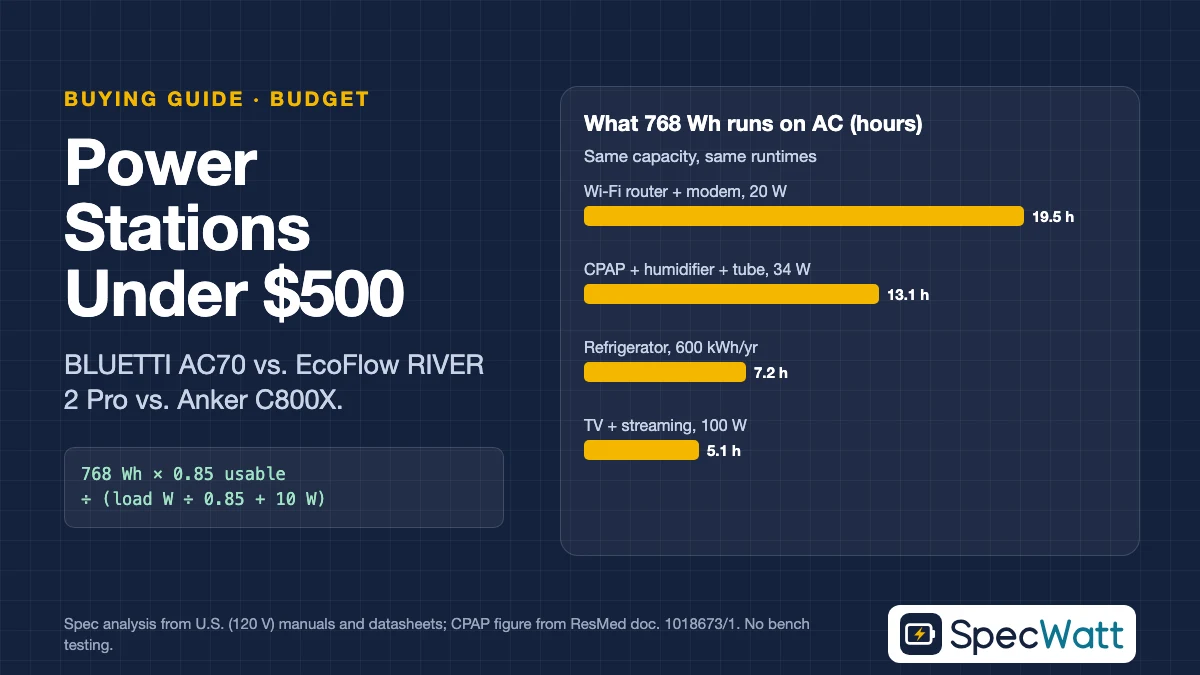
All three stations share the same capacity, so one set of runtimes covers all three. We used the same formula as our Power Station Runtime Calculator: 85% of rated capacity is usable, and AC loads draw through an 85%-efficient inverter plus 10 W of idle draw. The 10 W is our assumption: the AC70, RIVER 2 Pro and C800X documents we used don’t publish idle draw.
| Load (example, on AC) | Runtime on 768 Wh | Fits the AC rating of |
|---|---|---|
| Wi-Fi router and modem, 20 W | 19.5 h | All three |
| CPAP with humidifier and heated tube, 34 W | 13.1 h | All three |
| Refrigerator, 600 kWh/yr label (about 68 W average) | 7.2 h | All three |
| TV and streaming box, 100 W | 5.1 h | All three |
| Coffee maker or small microwave drawing 900 W | About 37 min | AC70 and C800X only |
Formula: hours = 768 Wh × 0.85 ÷ (load W ÷ 0.85 + 10 W). The CPAP figure is ResMed’s published average for an AirSense 10 with humidifier and heated tube (doc. 1018673/1). Example loads; check your appliance labels.
In practice, 768 Wh is a one-night battery. It keeps a router, lights and phones going through a long outage night, covers a CPAP for one night with room to spare and runs a refrigerator for about seven hours. It won’t keep a refrigerator cold through a full day; for that, see our home backup guide.
Best Budget: BLUETTI AC70
At $359 on BLUETTI’s U.S. store on November 18, 2026, the AC70 worked out to about $0.47 per rated watt-hour, the lowest cost per Wh of any power station under $500 we priced that day, which is why it gets Best Budget. Its manual lists 768 Wh of LiFePO4, 1,000 W of continuous AC output, a 12 V/10 A car port and a switchover of 20 ms or less when it is plugged into the wall, so a router or CPAP keeps running when the grid drops.
Its solar input is the strongest in this price range: one XT60 port that accepts 500 W at 12–58 V and 10 A. Turbo charging pulls up to 850 W from the wall, and BLUETTI lists 0–80% in 45 minutes in that mode. The trade-off is weight: at 22.5 lb, it is 5.3 lb heavier than the RIVER 2 Pro.
Who should skip it: anyone who carries the station on foot, and buyers who need more than 1,000 W of continuous AC.
Best Lightweight: EcoFlow RIVER 2 Pro
The RIVER 2 Pro wins Best Lightweight because it is the lightest of the three: its manual lists 17.2 lb (EcoFlow’s U.S. product page says 18.2 lb, still the lightest here), 768 Wh of LFP rated for 3,000 cycles to 80%, 800 W of AC output (1,600 W surge) and AC charging at up to 940 W. It was $369 on EcoFlow’s U.S. store on November 18, 2026, or about $0.48 per rated watt-hour, only $10 more than the AC70 that day.
Two limits keep it from the top spot. Its XT60 solar input stops at 220 W, so one 200 W panel is the practical maximum, and the documents we used don’t list an automatic switchover time, so we don’t recommend it for a CPAP or computer that has to ride through an outage without a gap. For CPAP use, check your device manual and talk to your doctor or equipment supplier.
Who should skip it: anyone who wants UPS-style backup or plans to charge from more than one panel.
Also Worth Considering: Anker SOLIX C800X
On paper, the C800X has the highest AC rating of the three: Anker’s U.S./Canada datasheet lists 1,200 W continuous (1,920 W surge), a UPS switchover under 20 ms, 768 Wh of LiFePO4 rated for 3,000+ cycles to 80% and a 300 W XT-60 solar input. That extra 200 W over the AC70 can matter for a coffee maker or a small space heater on its low setting.
Availability is the problem. On November 18, 2026, Anker’s U.S. store no longer listed the C800X, and its old product links redirected to other models, so we couldn’t collect a current price or confirm it still sells as a power station under $500. If you find it new at a retailer for less than the AC70, it’s a sound choice; otherwise, the AC70 or the RIVER 2 Pro is easier to buy and support.
Who should skip it: buyers who want to purchase from the manufacturer’s own store.
Worth Stretching For: 1,000 Wh Models Just Above $500
If no power station under $500 has enough capacity for your loads, two 1,000 Wh-class models were only slightly above the limit on the same day. The BLUETTI AC180 was $549 on BLUETTI’s U.S. store for 1,152 Wh and 1,800 W, which works out to about $0.48 per rated watt-hour, almost the same as the AC70. The Jackery Explorer 1000 v2 was $559 for 1,070 Wh, 1,500 W and 23.8 lb.
If your budget can stretch by about $190, the AC180 gives you 50% more capacity and 1,800 W of AC output, enough for many full-size microwaves (check the input watts on the label). Our 1000Wh comparison covers both models in detail.
How to Get the Most from a Budget Power Station
A fixed idle draw takes a bigger share of a small battery. The 10 W we assume in our formula adds up to 240 Wh over 24 hours, about 37% of a 768 Wh unit’s usable energy. As a general rule, run DC-capable loads from the 12 V and USB-C ports and turn the AC output off when nothing needs it.
Check solar compatibility before you buy panels. Each station’s voltage window and current limit is different, and the Voc & MPPT compatibility checker tells you whether a panel or a series string fits. Our solar panel connector guide shows which cable each station needs.
Frequently Asked Questions
For most buyers, the BLUETTI AC70: on November 18, 2026, it cost $359 on BLUETTI’s U.S. store for 768 Wh, 1,000 W of AC output, 500 W of solar input and a switchover of 20 ms or less. The EcoFlow RIVER 2 Pro is lighter at 17.2 lb.
About 19.5 hours for a 20 W router, 13 hours for a 34 W CPAP with humidifier and heated tube and 7 hours for a refrigerator rated 600 kWh per year, using 85% usable capacity and 85% inverter efficiency plus 10 W of idle draw.
Yes, for a limited time. A 768 Wh unit runs a refrigerator rated 600 kWh per year for about 7 hours. To cover a full day at that rate, our formula calls for about 2,600 Wh of rated capacity, or a way to recharge, such as solar panels.
The AC70 has more AC power (1,000 W vs. 800 W), more solar input (500 W vs. 220 W) and a published switchover of 20 ms or less. The RIVER 2 Pro is 5.3 lb lighter. Choose the AC70 for backup and solar, and the RIVER 2 Pro for carrying.
Yes. By our formula, a 768 Wh unit runs a ResMed AirSense 10 with humidifier and heated tube (34 W average) for about 13 hours on AC. Pick one with a published switchover, such as the AC70, and check with your doctor or equipment supplier.