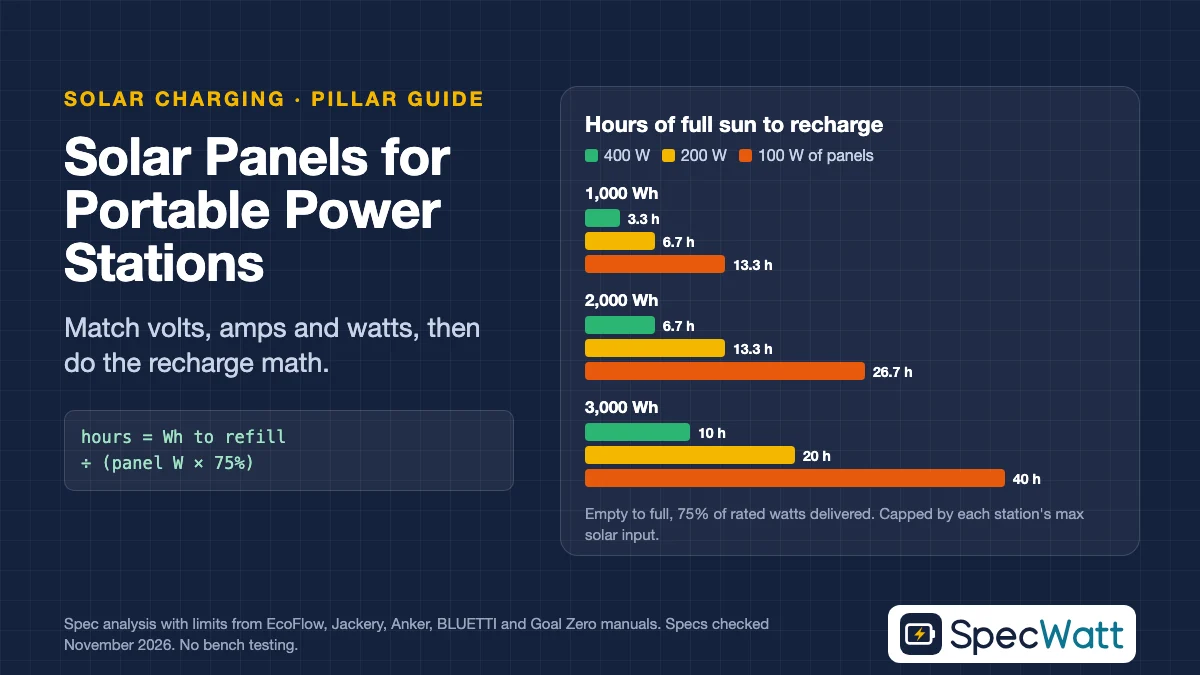
Choosing solar panels for portable power station charging comes down to one rule: the panel array has to fit inside the station’s solar input window on the coldest morning, and its wattage should match the input’s cap. Get that right and recharge time is simple arithmetic. A 1,000 Wh station with 400 W of panels needs roughly three hours of full sun; the same station with a single 100 W portable solar panel needs about 13.
This guide shows how to read your station’s solar input, how voltage, current and wattage limits work, and what recharge times look like for 1,000–3,000 Wh stations with 100 W, 200 W and 400 W of panels. Every product spec comes from a manufacturer’s manual, and the Solar Charging Time & Array Sizing Calculator runs the same recharge math for your own panel and station.
Start With Your Power Station’s Solar Input
The first spec to read when you shop for solar panels for portable power station charging isn’t on the panel at all. It’s the solar input line in your station’s manual: the connector, the voltage window, the maximum current and the maximum solar watts. These are the limits six popular stations publish, along with their battery capacity:
| Power station | Capacity | Solar connector | Voltage window | Max current | Max solar watts | Source (manual) |
|---|---|---|---|---|---|---|
| EcoFlow DELTA 3 Plus | 1,024 Wh | XT60i × 2 | Up to 60 V | Not listed in source | 500 W per port | EcoFlow 400W Lightweight Solar Panel manual |
| EcoFlow DELTA Pro | 3,600 Wh | XT60-type | Up to 150 V | Not listed in source | 1,600 W | EcoFlow 400W Lightweight Solar Panel manual |
| Jackery Explorer 1000 v2 | 1,070 Wh | DC8020 × 2 | 12–60 V | 10.5 A per port (16–60 V) | 400 W combined | Explorer 1000 v2 manual (JE-1000D), EU edition |
| Anker SOLIX C1000 | 1,056 Wh | XT-60 | 11–60 V | 10 A (11–32 V), 12.5 A (32–60 V) | 600 W | SOLIX C1000 manual (A1761), JP edition |
| BLUETTI AC180 | 1,152 Wh | DC7909 | 12–60 V | 10 A | 500 W | AC180 user manual |
| Goal Zero Yeti 3000 Lithium | 3,075 Wh | Anderson + 8 mm | 14–22 V | 30 A (Anderson) | 360 W combined | Yeti 3000 Lithium manual |
Specs checked November 2026. Confirm against the manual for your exact model number, because newer versions can change ports and limits.
Two lessons jump out. Similar-sized stations accept very different amounts of solar: the AC180 takes 500 W while the Explorer 1000 v2 tops out at 400 W across both ports. And voltage windows vary even more, from 22 V on the older Goal Zero to 150 V on the DELTA Pro, which decides how many panels you can wire in series.
U.S. Models We’d Shortlist, by Solar Input
If you’re matching solar panels for portable power station charging to a specific unit, start here. These U.S. models have 120 V manuals or official datasheets we checked, and the last column shows how long each takes to refill from 20% to 100% when the panels can feed the full solar input, using our 75% real-world assumption. More watts of panels than the cap don’t make it faster.
Models at a glance
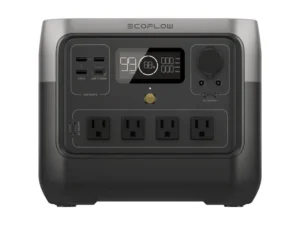
EcoFlow
RIVER 2 Pro
- Capacity768 Wh
- Solar connectorXT60
- Voltage window11–50 V
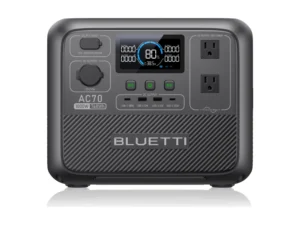
BLUETTI
AC70
- Capacity768 Wh
- Solar connectorXT60PM-M
- Voltage window12–58 V (Voc)
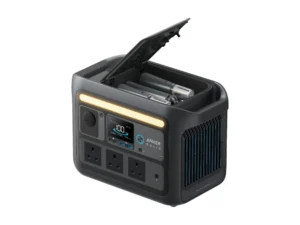
Anker SOLIX
C800X
- Capacity768 Wh
- Solar connectorXT-60
- Voltage window11–60 V
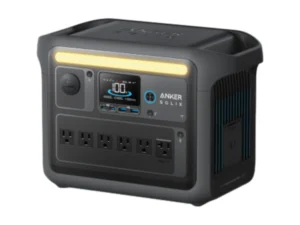
Anker SOLIX
C1000
- Capacity1,056 Wh
- Solar connectorXT-60
- Voltage window11–60 V
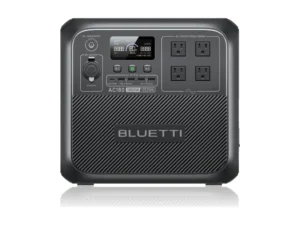
BLUETTI
AC180
- Capacity1,152 Wh
- Solar connectorDC7909
- Voltage window12–60 V
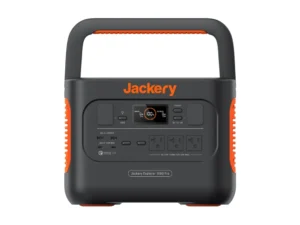
Jackery
Explorer 1000 Pro
- Capacity1,002 Wh
- Solar connectorDC8020 × 2
- Voltage window12–60 V
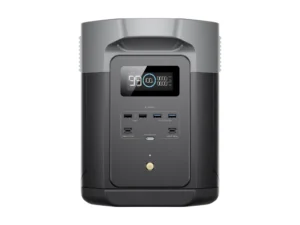
EcoFlow
DELTA 2 Max
- Capacity2,048 Wh
- Solar connectorXT60 × 2
- Voltage window11–60 V
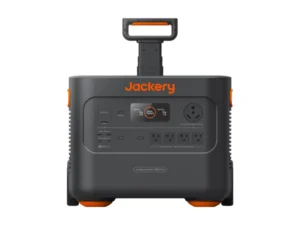
Jackery
Explorer 2000 Plus
- Capacity2,042.8 Wh
- Solar connectorDC8020 × 2
- Voltage window11–60 V
Specs from each model's U.S. manual or official datasheet. Full comparison in the table below. As an Amazon Associate we earn from qualifying purchases.
| Model | Capacity | Solar connector | Voltage window | Max current | Max solar W | 20%→100% at max input | Price |
|---|---|---|---|---|---|---|---|
| EcoFlow RIVER 2 Pro | 768 Wh | XT60 | 11–50 V | 13 A | 220 W | About 3.7 h | Check Price for EcoFlow RIVER 2 Pro (opens Amazon in a new tab) |
| BLUETTI AC70 | 768 Wh | XT60PM-M | 12–58 V (Voc) | 10 A | 500 W | About 1.6 h | Check Price for BLUETTI AC70 (opens Amazon in a new tab) |
| Anker SOLIX C800X | 768 Wh | XT-60 | 11–60 V | 10 A | 300 W | About 2.7 h | Check Price for Anker SOLIX C800X (opens Amazon in a new tab) |
| Anker SOLIX C1000 | 1,056 Wh | XT-60 | 11–60 V | 10 A / 12.5 A above 32 V | 600 W | About 1.9 h | Check Price for Anker SOLIX C1000 (opens Amazon in a new tab) |
| BLUETTI AC180 | 1,152 Wh | DC7909 | 12–60 V | 10 A | 500 W | About 2.5 h | Check Price for BLUETTI AC180 (opens Amazon in a new tab) |
| Jackery Explorer 1000 Pro | 1,002 Wh | DC8020 × 2 | 12–60 V | 8 A / 11 A above 17.5 V per port | 800 W | About 1.3 h | Check Price for Jackery Explorer 1000 Pro (opens Amazon in a new tab) |
| EcoFlow DELTA 2 Max | 2,048 Wh | XT60 × 2 | 11–60 V | 15 A per port | 1,000 W (500 W per port) | About 2.2 h | Check Price for EcoFlow DELTA 2 Max (opens Amazon in a new tab) |
| Jackery Explorer 2000 Plus | 2,042.8 Wh | DC8020 × 2 | 11–60 V | 8 A / 12 A above 17.5 V per port | 1,400 W | About 1.6 h | Check Price for Jackery Explorer 2000 Plus (opens Amazon in a new tab) |
Specs from each model’s U.S. (120 V) user manual or official Anker datasheet, checked November 2026. Prices change often, so confirm the current price and exact model on the retailer’s page.
The fast refill times assume an array big enough to hit each input’s cap, which often means two panels or more. Inputs with a 10–12 A limit also rule out large panels whose short-circuit current is above that, so check the panel’s Isc against the max current column before you buy solar panels for portable power station use, or run both through the Voc & MPPT Compatibility Checker.
Volts: Why Cold Mornings Can Overload the Solar Input
Voltage is the limit that damages hardware, and when people pick solar panels for portable power station inputs, it’s the one they misjudge most often. A panel’s open-circuit voltage (Voc) rises as it gets colder, so the label value, measured at 77°F (25°C), isn’t the worst case. BLUETTI’s AC180 manual states plainly that Voc above 60 V will damage the device.
The formula is cold Voc = label Voc × [1 + (temperature coefficient ÷ 100) × (coldest °C − 25)] × panels in series. EcoFlow’s 400 W lightweight panel (EF-FOLD-400-LW) lists 39.3 V Voc and −0.25% per °C, so on a 14°F (−10°C) morning one panel reaches about 42.7 V and two in series about 85.5 V. That’s fine on the DELTA Pro’s 150 V input and too much for any 60 V input.
Series Raises Volts, Parallel Raises Amps
Wiring panels in series adds their voltages; wiring them in parallel adds their currents. Series usually charges better in low light and loses less power in cables, which is why EcoFlow’s manual recommends it for its higher-voltage stations, but only parallel keeps the voltage of a 60 V input in range when you add panels.
Our series vs. parallel solar panels guide works through both options with real station limits, including when each one breaks the rules. If you’re combining several panels on a mid-size station, read it before you buy the second panel.
Amps and Watts: What Happens Above the Limits
When you pair solar panels for portable power station charging, current and wattage limits behave differently from voltage, and manuals handle them differently. Two EcoFlow 400 W panels in parallel produce 24.4 A of short-circuit current, about double the 12.5 A Anker lists for the SOLIX C1000 at 32–60 V and well over twice the 10 A BLUETTI lists for the AC180. EcoFlow’s own manual says parallel wiring of these panels isn’t recommended for exactly that reason. None of the manuals we cite describes what the input does with excess current, so treat the listed current as a hard limit, just like voltage, which BLUETTI’s manual says will damage the device above 60 V.
Wattage works differently. As a general rule, power above the cap is simply not used: if you connect 800 W of panels to a 500 W input, the station charges at no more than 500 W, a practice often called overpaneling. None of the manuals we cite publishes an overpaneling allowance, so stay at or under the listed watts unless your manual says otherwise, and never let extra panels push the voltage or current over the limits.
How Long It Really Takes to Recharge 1,000–3,000 Wh With Solar
Recharge time is the battery energy you need to replace divided by the power your panels actually deliver. Panels rarely deliver their full rating: heat, sun angle, dirt, cable losses and the charge controller all take a share, so we assume 75% of the rated watts reaches the battery. Here’s what that means for typical solar panels for portable power station setups, counting hours of full sun to refill the whole battery:
| Station capacity | 100 W of panels | 200 W of panels | 400 W of panels |
|---|---|---|---|
| 1,000 Wh | 13.3 h (about 2.7 days at 5 sun-hours) | 6.7 h (about 1.3 days) | 3.3 h (about 0.7 day) |
| 2,000 Wh | 26.7 h (about 5.3 days) | 13.3 h (about 2.7 days) | 6.7 h (about 1.3 days) |
| 3,000 Wh | 40 h (about 8 days) | 20 h (about 4 days) | 10 h (about 2 days) |
Assumptions: 75% of rated panel watts delivered; empty to full; 5 peak sun hours per day as an example. Results are capped by each station’s maximum solar input. Change any input in the calculator.
Peak sun hours depend heavily on where you live and the season, so treat 5 hours a day as an example, not a promise. NREL’s PVWatts calculator is the standard U.S. tool for monthly sun data at your address. Check the winter figure separately from the summer one, because shorter, lower-angle winter days deliver fewer peak sun hours and stretch these day counts. The table below shows how much the day count moves with 400 W of panels.
| Peak sun hours per day | 1,000 Wh | 2,000 Wh | 3,000 Wh |
|---|---|---|---|
| 3 hours | about 1.1 days | about 2.2 days | about 3.3 days |
| 4 hours | about 0.8 day | about 1.7 days | about 2.5 days |
| 5 hours | about 0.7 day | about 1.3 days | about 2 days |
| 6 hours | about 0.6 day | about 1.1 days | about 1.7 days |
400 W of panels at 75% of rated watts (300 W), empty to full. Days = hours of full sun ÷ peak sun hours.
Real Examples From the Manuals
Here’s how solar panels for portable power station charging work out on real models. Take the Jackery Explorer 1000 v2 (1,070 Wh, 400 W combined solar input). Refilling it from 20% to 100% means replacing about 856 Wh. Two 200 W panels, one per DC8020 port as Jackery’s manual describes, deliver roughly 300 W after losses, so that takes about 2.9 hours of full sun. A single 100 W panel delivers roughly 75 W and needs about 11.4 hours.
At the large end, an EcoFlow DELTA Pro (3,600 Wh) with two 400 W panels in series, the setup EcoFlow recommends, gets about 600 W after losses. Refilling it from 20% to 100% means replacing 2,880 Wh, or about 4.8 hours of full sun. The same panel on an Anker SOLIX C1000 (1,056 Wh) fits Anker’s 32–60 V band, where the manual allows 12.5 A against the panel’s 12.2 A, and refills 20% to 100% in about 2.8 hours. It would not suit a BLUETTI AC180, whose manual lists a 10 A maximum input current, which is a good reminder to check current as well as voltage. For a matched panel kit for each of five popular 1,000–2,000 Wh stations, with wiring and recharge hours, see our solar panel setup guide by model.
Foldable vs. Rigid Panels for a Power Station
A foldable solar panel is the default choice for power station solar charging, because it packs small and sets up fast. EcoFlow’s 400 W lightweight foldable panel, for example, is listed at about 22.5 lb (10.2 kg) with an IP68 rating, which works out to roughly 39 W per kilogram. It’s also bifacial: EcoFlow lists 445 W under its bifacial test conditions, which assume extra light reaching the back of the panel, versus 400 W at standard conditions.
As a general rule, and worth confirming on each spec sheet, rigid glass panels are heavier and bulkier per watt and need a frame or mount, but they tend to cost less per watt and suit a fixed spot, like a balcony railing, an RV roof or a shed. If your panels will stay in one place for months, rigid usually wins on price; if they travel or come out only during outages, a foldable solar panel usually wins on convenience. Our best portable solar panels comparison lines up seven EcoFlow, Jackery and BLUETTI foldable and rigid panels by Voc, Isc, connector and weight.
Connectors and Cables: MC4, XT60, DC8020 and Anderson
Most solar panels for portable power station setups end in MC4 connectors, while stations use XT60, XT60i, DC7909, DC8020 or Anderson Powerpole inputs, so nearly every setup needs the right adapter cable. The adapter only makes the plug fit; the voltage and current limits above still decide whether the panel is safe for the input.
Long extension cables also cost power. With a 25-foot run of 12 AWG cable carrying 10 A from a panel at 34.5 V, about 2.3% of the power turns into heat; with 14 AWG it’s closer to 3.7%. Our solar panel connector types guide lists each brand’s ports, the adapters they sell and the full voltage-drop math.
Charging a Power Station From an Apartment Balcony
A balcony panel that feeds only your power station is one of the simplest ways to use solar panels for portable power station charging in an apartment. The panel connects to the station’s solar input through its DC cable and charges the battery; nothing touches your home’s wiring or the outlets, so it’s a different product from grid-tied “plug-in” solar kits. You then run devices from the station’s own outlets.
Placement matters more than panel size on a balcony. As a general rule, railings force a steep or vertical angle and partial shade, which can cut output well below the rated watts, so lean the panel back toward the sun when you can and avoid shade on any part of it. Secure it against wind, route the cable through a door or window seal without pinching it, and check your lease or HOA rules before mounting anything on the railing.
Solar Charging During a Long Power Outage
During an outage, a portable solar panel turns a one-night battery into a multi-day plan. According to our CPAP battery backup guide, a CPAP with a heated humidifier and heated tube on AC uses about 400 Wh per 8-hour night, using ResMed’s published consumption data. A 400 W panel delivering about 300 W after losses replaces that in roughly 1.3 hours of full sun.
Bigger loads need bigger arrays of solar panels for portable power station charging. Refrigerators, sump pumps and space heaters can use more energy in a day than a small array can replace, so size the panels from your daily watt-hours, not the station’s capacity. Add up the daily watt-hours of every device you plan to run, then enter that total in the Solar Charging Time & Array Sizing Calculator to see how many hours of sun an array needs to put it back. All of our tools are on the Sizing & Calculators page.
What to Check Before You Buy Solar Panels for a Power Station
The checklist for solar panels for portable power station charging fits on one screen. Before you add any panel to your cart, compare its label with your station’s manual line by line, because a portable solar panel that looks like a perfect match on the product page can still miss one of these limits:
- Cold Voc: the array’s Voc on your coldest morning must stay below the station’s maximum input voltage.
- Minimum voltage: the array should sit comfortably above the input’s minimum so it starts charging early in the day.
- Current: the array’s short-circuit current should be within the station’s listed maximum.
- Watts: match the station’s maximum solar input; more watts than the cap is mostly wasted.
- Connector: know which adapter you need, and buy one rated above the panel’s short-circuit current.
- Weight and mounting: foldable for travel and outages, rigid for a fixed spot.
Solar charging is entirely DC; the U.S. 120 V / 60 Hz standard applies only to the station’s AC outlets and wall charger. UK/AU note: the solar math is the same worldwide, but stations sold there have 230 V / 50 Hz outlets and chargers, so buy the regional version. When you have a panel and a station in mind, run both through the Solar Panel Voc & MPPT Compatibility Checker before you buy to catch voltage and current problems, then use the Solar Charging Time & Array Sizing Calculator for the recharge time and any MPPT clipping. To shortlist panels by brand, start with our portable solar panel buyer’s guide; for ready-made kits for the DELTA 3 Plus, DELTA 2 Max, AC180, C1000 Gen 2 and Explorer 1000 v2, see the model-by-model setup guide.
Frequently Asked Questions
Solar panels for portable power station charging only work safely if the panel’s cold Voc, current and watts fit your station’s solar input, and you have the right connector or adapter. A panel that plugs in can still exceed the voltage limit, so check the manual first.
About 400 W of panels refill an empty 2,000 Wh station in roughly 6.7 hours of full sun, assuming 75% of rated watts. With 200 W it’s about 13 hours, so plan on two to three sunny days.
About 13 hours of full sun from empty, assuming 75% of the rated watts reaches the battery, or roughly 2.7 days at 5 peak sun hours a day. From 20% to full it’s closer to 10.7 hours.
Many models can. Jackery’s Explorer 1000 Pro manual says it charges from solar and AC together and gives solar priority, and Goal Zero’s Yeti manual allows solar and a wall charger at once. Check your model’s manual.
Yes, but at a fraction of their rated watts, depending on the clouds. Series wiring helps in low light because the voltage reaches the input’s minimum sooner, which is why EcoFlow recommends it for compatible stations.