Quick Verdict: Top Picks
- Best for Home CircuitsEcoFlow DELTA 2 MaxUp to 6,144 Wh with two extra batteries (about 58 h of a 600 kWh/yr fridge) and 1,000 W of solar input at 2,400 W AC.Check Price for EcoFlow DELTA 2 Max (opens Amazon in a new tab)
- Best Value 2 kWhEcoFlow DELTA 3 Max2,048 Wh and 2,400 W at about $0.43 per Wh on EcoFlow's U.S. store on Nov 19, 2026, with four 20 A outlets.Check Price for EcoFlow DELTA 3 Max (opens Amazon in a new tab)
Picks are based on the manufacturer specs and the math in this guide. Prices change often, so check the current price on Amazon.
A transfer switch for portable power station use lets a battery feed selected household circuits, such as the refrigerator, furnace blower or lights, without extension cords snaking through the house. It must be installed by a licensed electrician, with a permit where your town requires one, because it connects to your electrical panel.
The alternative people improvise, plugging a station into a wall outlet with a double-male cord, is called backfeeding, and CPSC calls it extremely dangerous. This guide explains the three safe ways to connect a power station to your house, what the code generally requires, the 120 V limits most stations have, and how to size the circuits you choose.
Three Safe Ways to Connect a Power Station to Your House
There are only three safe answers to how to connect a power station to your house, and two of them need an electrician. The simplest is no house connection at all: run heavy-duty extension cords from the station to the appliances you need. It costs nothing to install, but it can’t reach hardwired loads like a furnace blower or a ceiling light.
A manual transfer switch or a power inlet with a breaker interlock both feed real circuits. Either one, installed by a licensed electrician, works as a transfer switch for portable power station use, and either one physically prevents the panel from being connected to the utility and the station at the same time.
| Option | Electrician needed | What it powers | Key caution |
|---|---|---|---|
| Extension cords to appliances | No | Plug-in loads only | Use cords rated for the load; no cords under rugs or through closed doors |
| Manual transfer switch (pre-wired circuits) | Yes, plus permit where required | A set of chosen circuits | Only the circuits wired into the switch can run |
| Power inlet box + breaker interlock | Yes, plus permit where required | Any circuits you turn on in the panel | Interlock kit must be listed for your exact panel model |
| Double-male “suicide cord” into an outlet | Never acceptable | — | Backfeeds the utility line; risk of electrocution and fire |
Sources: CPSC Safety Alert “Portable Generator Hazards” (backfeeding); OSHA 3286 “Using Portable Generators Safely” (transfer switch installed by a qualified electrician). Checked November 19, 2026.
Why Backfeeding Through an Outlet Is Never Safe
Backfeeding means pushing power into a home’s wiring through an ordinary outlet. CPSC’s safety alert describes it as extremely dangerous: it can energize the utility line outside your house, putting line workers and neighbors at risk of electrocution, and it bypasses the protection built into your circuits. OSHA’s portable generator guidance says the same thing in practical terms: never connect directly to a building’s electrical system without a transfer switch installed by a qualified electrician.
The danger doesn’t shrink because the source is a battery instead of a gas generator. A power station’s inverter puts out 120 V AC, the same voltage as a generator outlet. The double-male cord also leaves exposed live prongs on the free end the moment one side is plugged in, and nothing stops grid power from returning while the station is still connected. That’s exactly what a transfer switch for portable power station use is built to prevent.
How a Transfer Switch for Portable Power Station Use Works
A transfer switch for portable power station use sits between your panel and the station. In the normal position, the chosen circuits take power from the utility; in the backup position, they take power from the inlet where the station plugs in. The switch, or the interlock, makes it mechanically impossible to select both at once, which is what stops backfeeding.
A manual switch also means manual timing. When the grid fails, those circuits go dark until you flip to backup, even if your station has a UPS feature. A station’s UPS switchover, such as the under 10 ms EcoFlow lists for the DELTA 3 Max, only protects devices plugged into the station’s own outlets, so keep a CPAP or a computer plugged into the station directly. As a general rule, don’t recharge the station from an outlet on a circuit it’s feeding through the transfer switch; ask your electrician which outlets stay on utility power.
Manual Transfer Switch vs Inlet and Interlock
A pre-wired manual transfer switch for portable power station backup has its own small set of circuit switches, and the electrician moves the chosen circuits onto it. It’s tidy and makes overloads less likely, because only those circuits can run. The downside is that you choose your backup circuits once, at installation.
An inlet box and interlock, the other common power station transfer switch setup, leaves every circuit in the main panel available: you switch off the main breaker, slide the interlock and turn on only the breakers you want. As a general rule, it’s more flexible and often less costly to install, but it relies on you to keep the total load under the station’s AC rating every time.
What the Code Generally Requires (NEC Article 702 Overview)
Any transfer switch for portable power station backup falls under the National Electrical Code, which treats a home backup source as an optional standby system under Article 702, which requires transfer equipment so the backup source can’t be connected to the utility at the same time. The section number has moved between editions (702.5 or 702.6), and each state or town adopts its own edition and amendments, so your electrician and local inspector set the final rules.
Whichever setup you choose, expect three things in most places: a permit and inspection, listed equipment (transfer switches are commonly listed to UL 1008, and interlock kits must be listed for the specific panel), and wiring sized to the inlet’s rating. None of this is a do-it-yourself job if you’re not licensed, and we don’t publish wiring steps for that reason.
The 120 V Limit: What a Power Station Can and Can’t Run
A transfer switch for portable power station backup can only pass along what the station puts out. Each station in this guide’s table lists 120 V AC output in its U.S. specs, and as a general rule a U.S. home panel is 120/240 V split-phase, so a 120 V source feeds 120 V circuits and leaves 240 V loads, such as a well pump, electric dryer, range or central air, without power. Your electrician will choose transfer equipment built for a 120 V source. UK/AU note: homes there use single-phase 230 V / 50 Hz and their own wiring rules, so the NEC and split-phase details here don’t apply.
Outlet rating matters too. EcoFlow’s U.S. page lists four 20 A outlets on the DELTA 3 Max, while BLUETTI lists the AC180’s outlets at 120 V and 15 A. As a general rule, the inlet, cord and breaker are sized to the outlet you’ll use, and the station’s continuous AC rating caps the total no matter how many circuits are turned on.
Questions to Ask Before the Electrician Arrives
Before you decide how to connect a power station to your house, a short list saves a second visit. Bring the station’s U.S. manual and these questions:
- Is the station’s AC output neutral bonded to ground, or floating? Ask the manufacturer in writing.
- Which outlet and cord will feed the inlet, and what’s its amp rating?
- Which circuits are 120 V, and what do they draw while running and starting?
- Does my town require a permit and inspection for an inlet or transfer switch?
The neutral question matters because it affects how the electrician wires the transfer equipment and how GFCI outlets behave on backup. It’s a detail manuals don’t always state, which is why we recommend asking the manufacturer rather than guessing.
Sizing Circuits on a Transfer Switch for Portable Power Station Backup
Pick circuits by running watts first, then check the biggest starting load. Honda’s generator wattage guide lists an Energy Star refrigerator at about 1,200 W to start and 132–192 W while running. On a station rated for 2,400 W continuous, that start leaves plenty of room for lights and a router; on a 1,800 W station, keep everything else small when the compressor kicks on.
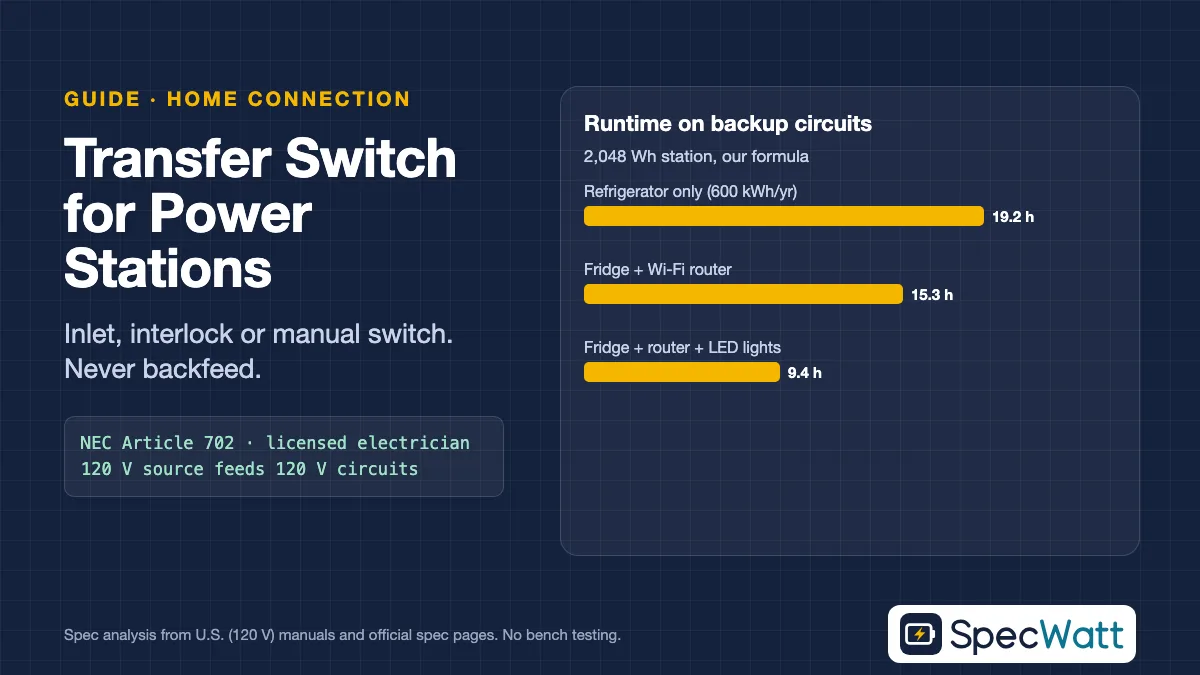
Runtime comes from average draw, not running watts. A refrigerator with a 600 kWh/year label averages about 68.5 W. Add a Wi-Fi router and some LED lights and you’re near 150 W of average load. The table shows runtime for each capacity class.
| Example load on backup circuits | 2,048 Wh class | 1,024 Wh class |
|---|---|---|
| Refrigerator only (600 kWh/yr label, 68.5 W average) | 19.2 h | 9.6 h |
| Refrigerator + Wi-Fi router (example 20 W) | 15.3 h | 7.6 h |
| Refrigerator + router + LED lighting (example 60 W) | 9.4 h | 4.7 h |
Formula: hours = rated Wh × 0.85 (usable energy) ÷ (average load W ÷ 0.85 inverter efficiency + 10 W idle). The 0.85 factors and 10 W idle draw are our assumptions, not manufacturer specs. Router and lighting watts are examples; check your own devices. Our runtime calculator runs the same math with your numbers.
Which Power Stations Suit a Home Inlet?
A home inlet or transfer switch for portable power station backup makes the most sense with a 2 kWh class station that has at least 2,400 W of continuous AC, because whole circuits add up fast. Use the model cards below as a starting point, then confirm with the manufacturer that the station is approved for connection through a transfer switch or inlet.
Models at a glance
EcoFlow
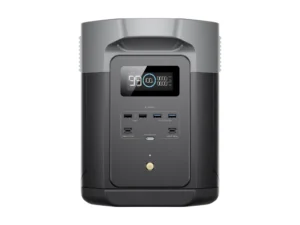
DELTA 2 Max
- Capacity2,048 Wh LFP
- AC output (120 V)2,400 W (4,800 W surge)
- ExpansionUp to 6,144 Wh with 2 extra batteries
Best for: Up to 6,144 Wh with two extra batteries (about 58 h of a 600 kWh/yr fridge) and 1,000 W of solar input at 2,400 W AC.
Check Price on Amazon for EcoFlow DELTA 2 Max (opens Amazon in a new tab)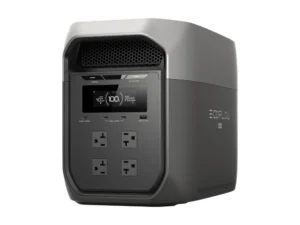
EcoFlow
DELTA 3 Max
- Capacity2,048 Wh LFP
- AC output (120 V)2,400 W (4,800 W surge)
- ExpansionNot listed (DELTA 3 Max Plus expands)
Best for: 2,048 Wh and 2,400 W at about $0.43 per Wh on EcoFlow's U.S. store on Nov 19, 2026, with four 20 A outlets.
Check Price on Amazon for EcoFlow DELTA 3 Max (opens Amazon in a new tab)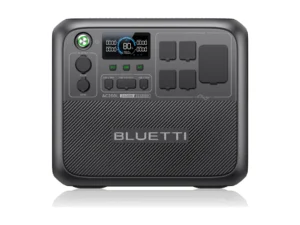
BLUETTI
AC200L
- Capacity2,048 Wh LiFePO4
- AC output (120 V)2,400 W, 20 A
- ExpansionUp to 8,192 Wh
Best for: The most expansion on paper (8,192 Wh) and 1,200 W of solar, but out of stock at BLUETTI's U.S. store on Nov 19, 2026.
Check Price on Amazon for BLUETTI AC200L (opens Amazon in a new tab)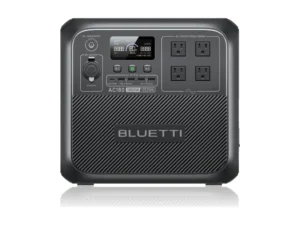
BLUETTI
AC180
- Capacity1,152 Wh LiFePO4
- AC output (120 V)1,800 W (2,700 W surge; 15 A outlets)
- ExpansionNot listed
Best for: A small inlet plan with one or two light circuits: 1,152 Wh and 1,800 W from 15 A outlets.
Check Price on Amazon for BLUETTI AC180 (opens Amazon in a new tab)Specs from each model's U.S. manual or official datasheet. Full comparison in the table below. As an Amazon Associate we earn from qualifying purchases.
| Model | Capacity | AC output (120 V) | Expansion | Solar input | Price |
|---|---|---|---|---|---|
| EcoFlow DELTA 2 Max | 2,048 Wh LFP | 2,400 W (4,800 W surge) | Up to 6,144 Wh with 2 extra batteries | 2 × 500 W (1,000 W) | Check Price for EcoFlow DELTA 2 Max (opens Amazon in a new tab) |
| EcoFlow DELTA 3 Max | 2,048 Wh LFP | 2,400 W (4,800 W surge) | Not listed (DELTA 3 Max Plus expands) | 500 W | Check Price for EcoFlow DELTA 3 Max (opens Amazon in a new tab) |
| BLUETTI AC200L | 2,048 Wh LiFePO4 | 2,400 W, 20 A | Up to 8,192 Wh | 1,200 W, 12–145 V | Check Price for BLUETTI AC200L (opens Amazon in a new tab) |
| BLUETTI AC180 | 1,152 Wh LiFePO4 | 1,800 W (2,700 W surge; 15 A outlets) | Not listed | 500 W, 12–60 V | Check Price for BLUETTI AC180 (opens Amazon in a new tab) |
Sources: EcoFlow DELTA 2 Max U.S. manual (EFD350) and U.S. page; EcoFlow DELTA 3 Max U.S. spec page; BLUETTI AC200L manual V3.0 (120 VAC); BLUETTI AC180 U.S. Tech Specs. Checked November 19, 2026.
Award criteria. Best for Home Circuits goes to the in-stock model with the most expansion and solar input at 2,400 W, and Best Value 2 kWh to the lowest price per rated watt-hour among 2 kWh models in stock at the maker’s U.S. store on November 19, 2026. The AC200L has the most expansion on paper, but BLUETTI’s U.S. store showed it out of stock that day, so it carries no award.
The DELTA 2 Max earns Best for Home Circuits: with two extra batteries EcoFlow lists 6,144 Wh, about 58 hours of a 600 kWh/year refrigerator by our formula, and two solar inputs to refill it. The DELTA 3 Max is Best Value 2 kWh at $879 on EcoFlow’s U.S. store on November 19, 2026, about $0.43 per Wh. The AC180 fits a small inlet plan with one or two light circuits; see our home backup guide for full picks. Skip the DELTA 2 Max if 50 lb is too heavy to move between rooms; skip the DELTA 3 Max if you’ll want more than 2,048 Wh later, since its U.S. page lists no extra battery.
Our Verdict
A transfer switch for portable power station use is the right way to run hardwired circuits in an outage, but only with a licensed electrician, the permit your town requires and equipment built for a 120 V source. Never backfeed through an outlet. For plug-in loads alone, extension cords to the appliances are safe and cost nothing to set up.
If you’re still choosing a station, start with the circuits you’d keep on and work backward to capacity with our sizing guide. A refrigerator-first plan is covered in our refrigerator backup guide. Check current prices in the model cards above.
Frequently Asked Questions
No. That’s backfeeding, which CPSC calls extremely dangerous: it can energize the utility line and bypass your circuit protection. Use extension cords to appliances, or have a licensed electrician install a transfer switch or inlet with an interlock.
Yes. A transfer switch or inlet connects to your electrical panel, and OSHA guidance says it must be installed by a qualified electrician. Most towns also require a permit and inspection under their adopted edition of the NEC.
Not the stations in this guide: their U.S. specs list 120 V AC output only, so they feed 120 V circuits, and no power station transfer switch changes that. A 240 V well pump, dryer, range or central air won’t run from a 120 V source through a transfer switch.
When it’s listed for your exact panel and installed by a licensed electrician, an interlock does the same job: it prevents the main breaker and the backup breaker from being on together. The difference is flexibility versus a fixed set of circuits.
No. With a manual switch, the circuits go dark until you flip it. A station’s UPS switchover only protects devices plugged into its own outlets, so keep a CPAP or computer plugged into the station directly.