Quick Verdict: Top Picks
- Best BudgetBLUETTI AC70The 768 Wh class at about $0.47 per Wh on Nov 18, 2026: about two CPAP nights with a humidifier.Check Price for BLUETTI AC70 (opens Amazon in a new tab)
- Best ValueBLUETTI AC180The 1,000 Wh class at about $0.48 per Wh on Nov 19, 2026, with 1,800 W for a refrigerator start.Check Price for BLUETTI AC180 (opens Amazon in a new tab)
- Best 2 kWh ValueEcoFlow DELTA 3 MaxThe 2,048 Wh class at about $0.43 per Wh on Nov 19, 2026: about 19 hours of a 600 kWh/yr refrigerator.Check Price for EcoFlow DELTA 3 Max (opens Amazon in a new tab)
Picks are based on the manufacturer specs and the math in this guide. Prices change often, so check the current price on Amazon.
What size power station do I need? Add up the watt-hours your devices use over the time you need power, divide by about 0.72 to cover inverter losses and usable capacity (plus a little for idle draw), and make sure the AC rating clears your biggest starting load. A CPAP night fits a 768 Wh station; a refrigerator through a full day needs more than 2,048 Wh.
It’s easy to size by watts and run short on watt-hours, or the other way around. This guide walks through both numbers with loads that come from manufacturer documents, then maps them to three common U.S. capacity classes: about 768 Wh, about 1,000 Wh and 2,048 Wh.
Two Numbers Decide the Size: Watt-Hours and Watts
Watt-hours (Wh) are the size of the tank. They decide how long your devices run. Watts (W) are the size of the pipe. The station’s continuous AC rating has to be higher than everything running at once, and higher than the brief spike when a motor or compressor starts.
Answering “what size power station do I need” means checking both. A 2,048 Wh station rated for 2,400 W can run a refrigerator for most of a day, while a 768 Wh station rated for 800 W, such as the EcoFlow RIVER 2 Pro, sits below the roughly 1,200 W a refrigerator can draw to start. Capacity without enough watts fails at the start; watts without capacity fails in the middle of the night.
Step 1: Add Up the Energy Your Devices Use
To answer what size power station do I need for your home, list each device, its average watts and the hours you need it, then multiply. For loads that cycle on and off, use the average, not the peak. A refrigerator with a 600 kWh/year EnergyGuide label averages about 68.5 W (600,000 Wh ÷ 8,760 h), even though its compressor draws far more while running.
| Device (source) | Average watts | Hours | Energy at the outlet |
|---|---|---|---|
| ResMed Air10 CPAP with humidifier (ResMed doc. 1018673/1) | 22 W | 8 | 176 Wh |
| Refrigerator, 600 kWh/yr label | 68.5 W | 24 | 1,644 Wh |
| Starlink Mini (Starlink average, upper end) | 40 W | 8 | 320 Wh |
| Starlink Standard (Starlink average, upper end) | 100 W | 8 | 800 Wh |
| Wi-Fi router (example; check your label) | 20 W | 24 | 480 Wh |
ResMed figure is Wh per hour with the humidifier from doc. 1018673/1; Starlink averages from Starlink’s help center (Mini 20–40 W; Standard 4 / Standard 4 X 75–100 W; the older Standard Actuated is 50–75 W). The router is an example value.
When you work out what size portable power station do I need for your own home, your labels beat any table. Most devices list input watts or amps on the power supply. As a general rule, multiply amps by 120 V for a worst-case watts figure (in the UK or Australia, use 230 V). For anything with a compressor or motor, the yearly kWh on the EnergyGuide label gives you a dependable average (kWh/year × 1,000 ÷ 8,760 h).
Step 2: Convert to the Station Size You Need
A power station never delivers its full label capacity to your devices. Its inverter loses energy turning DC into 120 V AC, it holds back some capacity to protect the battery, and it draws a little power just by being on. Our formula covers all three:
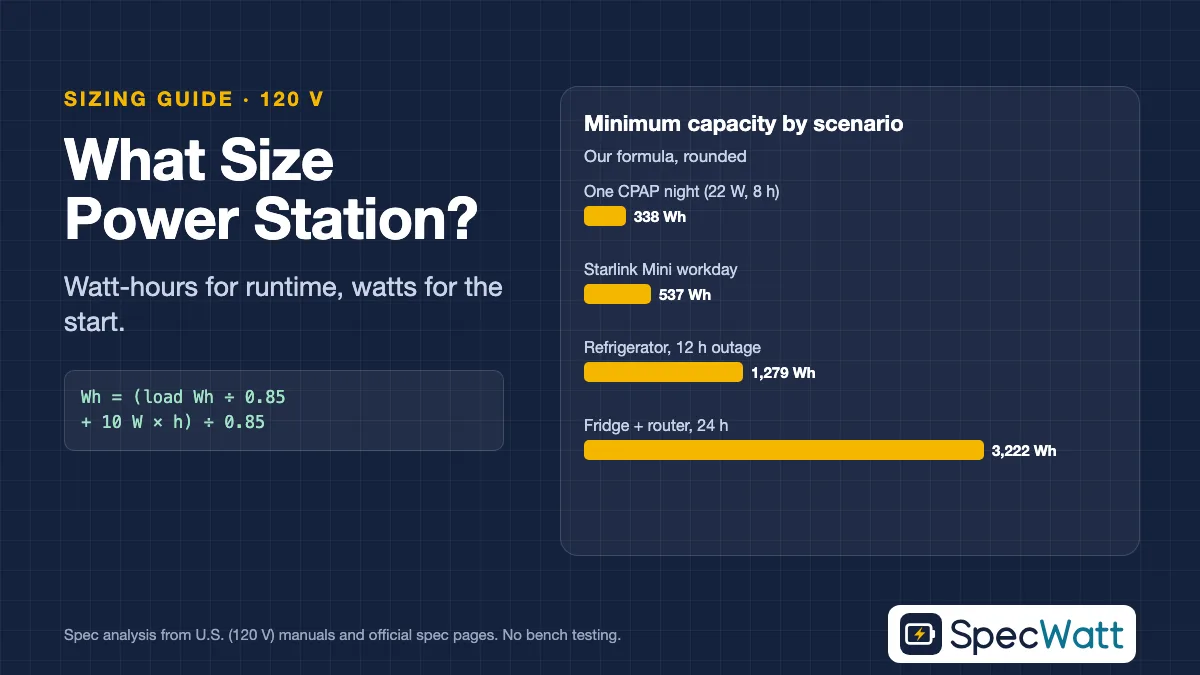
Required capacity (Wh) = (outlet Wh ÷ 0.85 + 10 W × hours) ÷ 0.85
That assumes an 85%-efficient inverter, 10 W of idle draw and 85% usable capacity, the same assumptions as our runtime calculator. For the CPAP night above: 176 ÷ 0.85 = 207 Wh, plus 80 Wh of idle draw, then ÷ 0.85 = about 338 Wh. As a general rule, loads powered over USB-C or 12 V DC skip the inverter; our Starlink guide assumes about 90% converter efficiency for USB-C instead of 85% (our assumption, not a manufacturer spec). If you’ll rely on a CPAP, check its manual and talk to your doctor or equipment supplier before sizing around it.
Step 3: Check Starting Watts Against the AC Rating
Motors and compressors pull a spike for a second or two when they start. Honda’s generator wattage guide lists an Energy Star refrigerator at about 1,200 W to start and 132–192 W while running. As a general rule, if that spike plus everything else running is above the station’s continuous AC rating, the station’s overload protection can shut the output off.
As a general rule, pick a station whose continuous rating is above your largest starting load plus the running watts of everything else. Surge ratings help with the spike, but they’re not a promise for every motor. BLUETTI’s Power Lifting figures, for example, apply to resistive loads such as heaters, not compressors.
Real-World Load Examples, Sized
These five scenarios show what size power station you need for common situations, using the formula above. Each answer is the minimum nominal capacity; rounding up to the next class gives you margin for cold weather, battery aging and the loads you forgot.
| Scenario | Outlet energy | Minimum capacity | Class that fits |
|---|---|---|---|
| One CPAP night (Air10 + humidifier, 8 h) | 176 Wh | About 338 Wh | 768 Wh |
| Starlink Mini workday (8 h on AC) | 320 Wh | About 537 Wh | 768 Wh |
| Starlink Standard workday (8 h on AC) | 800 Wh | About 1,201 Wh | 2,048 Wh |
| Refrigerator, 12-hour outage | 822 Wh | About 1,279 Wh | 2,048 Wh |
| Refrigerator + router, 24-hour outage | 2,124 Wh | About 3,222 Wh | 2,048 Wh + extra battery |
Minimum capacity = (outlet Wh ÷ 0.85 + 10 W × hours) ÷ 0.85, rounded. A 1,000 Wh class station covers about 9.6 hours of the refrigerator alone.
The last row is the one that surprises people. A full day of refrigerator and router needs about 3.2 kWh of nominal capacity, more than any single 2 kWh station holds. That’s where an expandable model, such as the EcoFlow DELTA 2 Max with up to 6,144 Wh, or solar recharging during the day, comes in.
What Size Power Station Do I Need for Camping?
When you ask what size power station do I need for camping, remember that weight matters as much as capacity, so size for one day and recharge with solar. A Starlink Mini for 8 hours plus a CPAP night comes to about 875 Wh of nominal capacity by our formula, which fits a 1,000 Wh class station. The Jackery Explorer 1000 v2 carries 1,070 Wh at 23.8 lb, about 45 Wh per pound (sold out at Jackery’s U.S. store on November 19, 2026).
If you camp without internet, a 768 Wh station is usually enough for a CPAP and phone charging (check your CPAP’s manual for its DC or AC options first), and the EcoFlow RIVER 2 Pro weighs about 17.2 lb. Check our camping and RV guide for full picks and our solar charging calculator to see how fast a panel refills it.
Runtime by Capacity Class
Turning the question around helps too: instead of asking what size power station do I need, ask how long each size lasts. The table runs four common loads through our formula for each class. Real stations in each class vary by up to about 12% in rated capacity: the BLUETTI AC180 holds 1,152 Wh against the 1,024 Wh reference.
| Load (average watts) | 768 Wh class | 1,024 Wh class | 2,048 Wh class |
|---|---|---|---|
| Wi-Fi router (example 20 W) | 19.5 h | 26.0 h | 51.9 h |
| CPAP with humidifier (22 W) | 18.2 h | 24.3 h | 48.5 h |
| Refrigerator, 600 kWh/yr (68.5 W) | 7.2 h | 9.6 h | 19.2 h |
| Starlink Standard (100 W) | 5.1 h | 6.8 h | 13.6 h |
Hours = rated Wh × 0.85 ÷ (load W ÷ 0.85 + 10 W idle). Classes use 768, 1,024 and 2,048 Wh as reference capacities.
Use the column that matches the station you’re looking at, then scale by its real capacity: an AC180 at 1,152 Wh runs about 12% longer than the 1,024 Wh column shows. For your own loads, the runtime calculator uses the same 85% / 10 W / 85% assumptions.
Stations by Size Class
The cards below show one or more U.S. models per class, all with specs from their maker’s U.S. manual or spec page. Once you know what size power station you need from the tables above, compare models inside that class on AC rating, switchover time and weight.
Models at a glance
BLUETTI
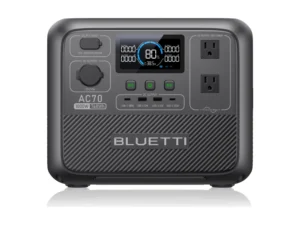
AC70
- Capacity768 Wh LiFePO4
- AC output (120 V)1,000 W
- Weight22.5 lb
Best for: The 768 Wh class at about $0.47 per Wh on Nov 18, 2026: about two CPAP nights with a humidifier.
Check Price on Amazon for BLUETTI AC70 (opens Amazon in a new tab)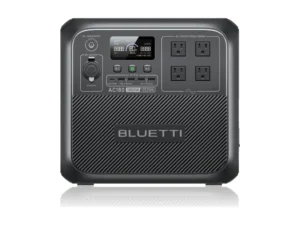
BLUETTI
AC180
- Capacity1,152 Wh LiFePO4
- AC output (120 V)1,800 W
- Weight35.3 lb
Best for: The 1,000 Wh class at about $0.48 per Wh on Nov 19, 2026, with 1,800 W for a refrigerator start.
Check Price on Amazon for BLUETTI AC180 (opens Amazon in a new tab)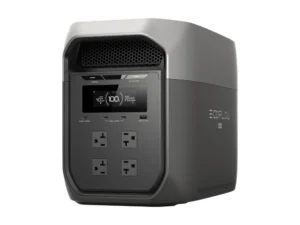
EcoFlow
DELTA 3 Max
- Capacity2,048 Wh LFP
- AC output (120 V)2,400 W
- WeightAbout 44.8 lb
Best for: The 2,048 Wh class at about $0.43 per Wh on Nov 19, 2026: about 19 hours of a 600 kWh/yr refrigerator.
Check Price on Amazon for EcoFlow DELTA 3 Max (opens Amazon in a new tab)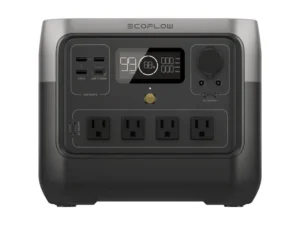
EcoFlow
RIVER 2 Pro
- Capacity768 Wh LFP
- AC output (120 V)800 W
- WeightAbout 17.2 lb
Anker SOLIX
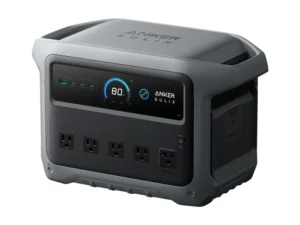
C1000 Gen 2
- Capacity1,024 Wh
- AC output (120 V)2,000 W
- Weight24.9 lb
EcoFlow
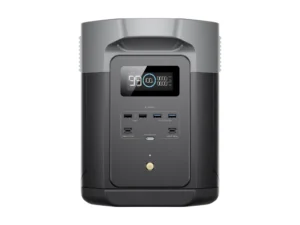
DELTA 2 Max
- Capacity2,048 Wh LFP
- AC output (120 V)2,400 W
- WeightAbout 50 lb
Specs from each model's U.S. manual or official datasheet. Full comparison in the table below. As an Amazon Associate we earn from qualifying purchases.
| Model | Class | Capacity | AC output (120 V) | Weight | Price |
|---|---|---|---|---|---|
| BLUETTI AC70 | 768 Wh | 768 Wh LiFePO4 | 1,000 W | 22.5 lb | Check Price for BLUETTI AC70 (opens Amazon in a new tab) |
| EcoFlow RIVER 2 Pro | 768 Wh | 768 Wh LFP | 800 W | About 17.2 lb | Check Price for EcoFlow RIVER 2 Pro (opens Amazon in a new tab) |
| BLUETTI AC180 | 1,000 Wh | 1,152 Wh LiFePO4 | 1,800 W | 35.3 lb | Check Price for BLUETTI AC180 (opens Amazon in a new tab) |
| Anker SOLIX C1000 Gen 2 | 1,000 Wh | 1,024 Wh | 2,000 W | 24.9 lb | Check Price for Anker SOLIX C1000 Gen 2 (opens Amazon in a new tab) |
| EcoFlow DELTA 3 Max | 2,048 Wh | 2,048 Wh LFP | 2,400 W | About 44.8 lb | Check Price for EcoFlow DELTA 3 Max (opens Amazon in a new tab) |
| EcoFlow DELTA 2 Max | 2,048 Wh | 2,048 Wh LFP | 2,400 W | About 50 lb | Check Price for EcoFlow DELTA 2 Max (opens Amazon in a new tab) |
Sources: BLUETTI AC70 and AC180 U.S. manuals and Tech Specs; EcoFlow RIVER 2 Pro and DELTA 2 Max U.S. manuals; EcoFlow DELTA 3 Max U.S. spec page; Anker SOLIX C1000 Gen 2 U.S. Specs tab. Jackery Explorer 1000 v2: Tech Specs tab of Jackery’s U.S. product page. Checked November 18–19, 2026.
Award criteria. Each class gets one pick for the lowest price per rated Wh at the maker’s U.S. store (Best Budget, Best Value and Best 2 kWh Value): the AC70 at $359 on November 18, 2026 (about $0.47/Wh), the AC180 at $549 on November 19 (about $0.48/Wh) and the DELTA 3 Max at $879 on November 19 (about $0.43/Wh). Prices change, so use the buttons on the cards to see the current price.
Watch the AC rating in the smallest class. The RIVER 2 Pro’s 800 W and the AC70’s 1,000 W are enough for a CPAP or a router, but both sit below the roughly 1,200 W start Honda lists for an Energy Star refrigerator. As a general rule, if a fridge is on your list, start at the 1,000 Wh class with at least 1,800 W, which leaves margin over that start plus the other loads. Skip the AC70 if a refrigerator is on your list; skip the AC180 if you need more than about 10 hours of a 600 kWh/yr fridge; skip the DELTA 3 Max if you need expansion, because its U.S. page lists no extra battery.
Our Verdict
What size power station do I need comes down to your longest outage and your largest motor. For a CPAP night or a day of Starlink Mini, a 768 Wh station is enough. For a refrigerator through an overnight outage, choose the 2,048 Wh class. For a full day of refrigerator and router, plan on expansion or solar.
Run your own list through our sizing calculators before you buy. For home outages, our home backup guide and refrigerator guide go deeper; if you’ll rely on a CPAP, check its manual and talk to your doctor or equipment supplier first.
Frequently Asked Questions
For a 600 kWh/year refrigerator, a 2,048 Wh station runs it about 19 hours and a 1,024 Wh station about 9.6 hours under our assumptions. Pick a station with at least 1,800 W of continuous AC to clear a roughly 1,200 W start.
Multiply each device’s average watts by the hours you need it and add them up. Then required Wh = (that total ÷ 0.85 + 10 W × hours) ÷ 0.85. Finally, check that the AC rating clears your biggest starting load.
For one night of essentials, yes: about 24 hours of a CPAP with humidifier or about 9.6 hours of a 600 kWh/year refrigerator. For longer outages, choose 2,048 Wh or add solar recharging.
A ResMed Air10 with humidifier averages 22 Wh per hour, so an 8-hour night needs about 338 Wh of nominal capacity on AC. A 768 Wh station covers about two nights. Check your CPAP’s manual and talk to your doctor before relying on it.