Quick Verdict: Top Picks
- Best OverallBLUETTI SP200LPublished 24.6 V Voc and 10.8 A Isc with MC4; two in series stay near 54 V on a cold morning, inside a 60 V input.Check Price for BLUETTI SP200L (opens Amazon in a new tab)
- Most PortableJackery SolarSaga 100 AirThe lightest of the six panels here with a published weight (7.1 lb), with bifacial PERC cells Jackery rates at 23% efficiency.Check Price for Jackery SolarSaga 100 Air (opens Amazon in a new tab)
- Best High-OutputBLUETTI 350W Solar PanelThe most power from one in-stock panel here (350 W), MC4 and 33 V Voc; check the label Isc against your station's input current.Check Price for BLUETTI 350W Solar Panel (opens Amazon in a new tab)
Picks are based on the manufacturer specs and the math in this guide. Prices change often, so check the current price on Amazon.
The best portable solar panels for a power station are the ones whose open-circuit voltage (Voc) and short-circuit current (Isc) fit your station’s solar input, with a connector that plugs in without a pile of adapters. Rated watts come third. Of the seven EcoFlow, Jackery and BLUETTI panels we compare, the BLUETTI SP200L is the strongest all-round buy in stock on November 19, 2026.
This is a brand-by-brand buyer’s guide, not a how-to. If you want the volts, amps and recharge math explained from scratch, start with our solar panels for portable power station guide. Here we line up real 100 W to 400 W panels from the three big station brands and show which station each one actually fits.
Our Top Picks: Award Criteria and Who Should Skip Each
Every award for the best portable solar panels below comes from the specs in the comparison table and stock at each maker’s U.S. store on November 19, 2026. We only give an award to a panel we could buy new from the maker that day, which is why none of EcoFlow’s panels carries one: all three showed as unavailable on EcoFlow’s U.S. store.
| Award | Pick | Why it wins | Who should skip it |
|---|---|---|---|
| Best Overall | BLUETTI SP200L | 200 W, 24.6 V Voc, MC4, two fit in series on a 60 V input | AC180 owners: its 10.8 A Isc is above the AC180’s listed 10 A |
| Most Portable | Jackery SolarSaga 100 Air | 7.1 lb, the lightest of the six with a published weight | Anyone who needs a published Voc and Isc before buying |
| Best High-Output | BLUETTI 350W Solar Panel | 350 W from one panel, MC4 | Owners of 60 V stations who want two in series (66 V Voc) |
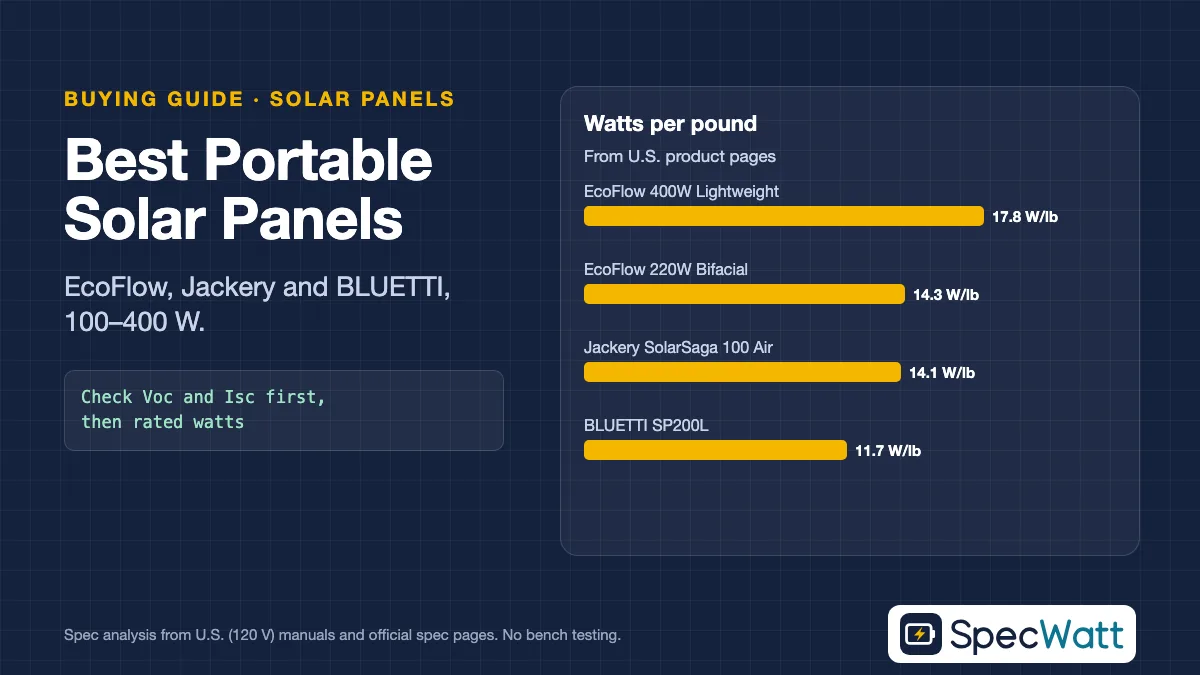
Award criteria. Best Overall needs a published Voc and Isc, a standard MC4 connector and room for two panels in series on a 60 V input, among panels in stock. Most Portable is the lowest weight; Best High-Output is the highest rating from a single panel in stock. The EcoFlow 400W Lightweight has the best watts per pound of the six with a published weight (about 17.8 W/lb) but was unavailable on EcoFlow’s U.S. store on November 19, 2026.
Comparison: Seven Portable Solar Panels at a Glance
The table puts the numbers that decide compatibility for the best portable solar panels side by side. Voc must stay under your station’s voltage limit, even on a cold morning, and Isc must stay at or under its current limit. Where a maker’s U.S. page didn’t publish a figure, the table says so rather than filling it in.
Models at a glance
Jackery
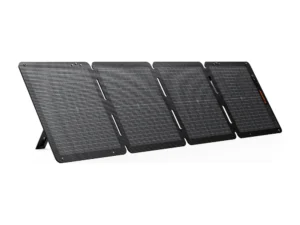
SolarSaga 100 Air
- Rated power100 W
- VocNot on U.S. page
- IscNot on U.S. page
Best for: The lightest of the six panels here with a published weight (7.1 lb), with bifacial PERC cells Jackery rates at 23% efficiency.
Check Price on Amazon for Jackery SolarSaga 100 Air (opens Amazon in a new tab)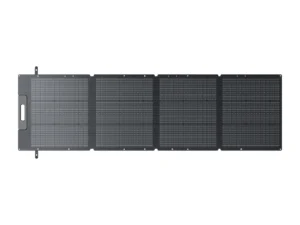
BLUETTI
SP200L
- Rated power200 W
- Voc24.6 V
- Isc10.8 A
Best for: Published 24.6 V Voc and 10.8 A Isc with MC4; two in series stay near 54 V on a cold morning, inside a 60 V input.
Check Price on Amazon for BLUETTI SP200L (opens Amazon in a new tab)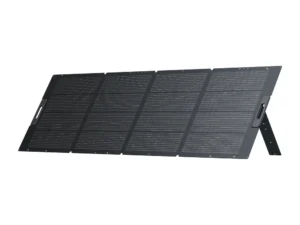
BLUETTI
350W Solar Panel
- Rated power350 W
- Voc33 V
- IscNot on U.S. page
Best for: The most power from one in-stock panel here (350 W), MC4 and 33 V Voc; check the label Isc against your station's input current.
Check Price on Amazon for BLUETTI 350W Solar Panel (opens Amazon in a new tab)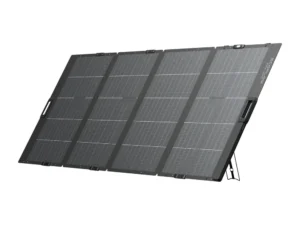
EcoFlow
400W Lightweight Solar Panel
- Rated power400 W
- Voc39.3 V
- Isc12.2 A
Best for: The best watts per pound of the six with a published weight (about 17.8 W/lb) and EcoFlow's one-per-input pairing, but unavailable at EcoFlow's U.S. store on Nov 19, 2026.
Check Price on Amazon for EcoFlow 400W Lightweight Solar Panel (opens Amazon in a new tab)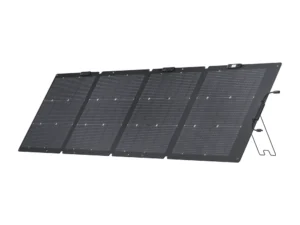
EcoFlow
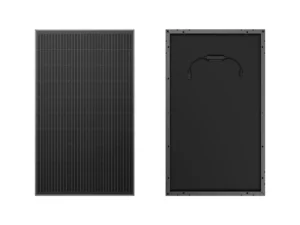
220W Bifacial Solar Panel
- Rated power220 W front (175 W rear)
- Voc21.5 V
- Isc12.4 A
EcoFlow
100W Rigid Solar Panel
- Rated power100 W
- Voc20.3 V
- Isc6.3 A
Jackery
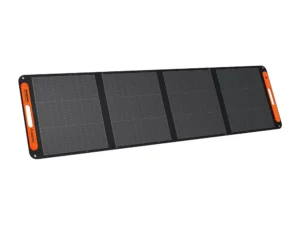
SolarSaga 200W
- Rated power200 W
- Voc22 V
- Isc12.5 A
Specs from each model's U.S. manual or official datasheet. Full comparison in the table below. As an Amazon Associate we earn from qualifying purchases.
| Model | Rated power | Voc | Isc | Connector | Weight | Price |
|---|---|---|---|---|---|---|
| EcoFlow 400W Lightweight Solar Panel | 400 W | 39.3 V | 12.2 A | XT60i | 22.49 lb | Check Price for EcoFlow 400W Lightweight Solar Panel (opens Amazon in a new tab) |
| EcoFlow 220W Bifacial Solar Panel | 220 W front (175 W rear) | 21.5 V | 12.4 A | PV (MC4-type) | About 15.4 lb | Check Price for EcoFlow 220W Bifacial Solar Panel (opens Amazon in a new tab) |
| EcoFlow 100W Rigid Solar Panel | 100 W | 20.3 V | 6.3 A | Check listing | 13.7 lb | Check Price for EcoFlow 100W Rigid Solar Panel (opens Amazon in a new tab) |
| Jackery SolarSaga 200W | 200 W | 22 V | 12.5 A | Jackery DC8020 | 14.33 lb | Check Price for Jackery SolarSaga 200W (opens Amazon in a new tab) |
| Jackery SolarSaga 100 Air | 100 W | Not on U.S. page | Not on U.S. page | Check listing | 7.1 lb | Check Price for Jackery SolarSaga 100 Air (opens Amazon in a new tab) |
| BLUETTI SP200L | 200 W | 24.6 V | 10.8 A | MC4 | 17.15 lb | Check Price for BLUETTI SP200L (opens Amazon in a new tab) |
| BLUETTI 350W Solar Panel | 350 W | 33 V | Not on U.S. page | MC4 | Not on U.S. page | Check Price for BLUETTI 350W Solar Panel (opens Amazon in a new tab) |
Sources: EcoFlow 400W Lightweight manual (EF-FOLD-400-LW) and EcoFlow U.S. product pages; Jackery product pages and listings; BLUETTI U.S. product pages. Checked November 19, 2026. Isc is the front-side figure for the bifacial panel.
Weight per watt shows how much panel you carry for the power you get. The EcoFlow 400W gives about 17.8 W per pound, the EcoFlow 220W about 14.3, the SolarSaga 100 Air about 14.1, the SolarSaga 200W about 14.0, the SP200L about 11.7 and the rigid EcoFlow 100W about 7.3, which is why rigid panels suit a roof rack better than a backpack. Prices on the best portable solar panels move often, so we keep them out of the table. On November 19, 2026, the maker’s U.S. stores listed the SP200L at $399 (about $2.00 per watt), the BLUETTI 350W at $649 (about $1.85 per watt) and the SolarSaga 100 Air at $299 (about $2.99 per watt); check the cards above for current prices.
How to Read Voc and Isc Before You Buy
Voc is the voltage a panel produces with nothing connected, and it climbs as the panel gets colder. The best portable solar panels for your setup keep the cold-morning Voc, times the number of panels in series, under your station’s maximum. EcoFlow’s 400W panel lists −0.25% per °C, so one panel reaches about 42.7 V at 14°F (−10°C).
Isc is the current a panel produces into a short circuit, the most it can push. On a spec sheet, this number matters as much as Voc. None of the station manuals we cite describes what happens above the listed input current, so we treat that number as a hard limit, as our solar panel guide explains. That rule eliminates several tempting pairings below.
A Quick Cold-Voltage Check for Two Panels in Series
As a general rule, add about 10% to the label Voc for freezing mornings when the maker doesn’t publish a temperature coefficient (about −0.3% per °C over a 35°C drop). The table applies that margin to two identical panels in series and compares the result with a 60 V input, the limit on every station in our fit table below.
| Two panels in series | Label Voc | Cold estimate | On a 60 V input |
|---|---|---|---|
| 2 × EcoFlow 100W Rigid | 40.6 V | About 44.7 V | Fits |
| 2 × EcoFlow 220W Bifacial | 43.0 V | About 47.3 V | Fits |
| 2 × Jackery SolarSaga 200W | 44.0 V | About 48.4 V | Fits |
| 2 × BLUETTI SP200L | 49.2 V | About 54.1 V | Fits |
| 2 × BLUETTI 350W | 66.0 V | About 72.6 V | Too high |
| 2 × EcoFlow 400W | 78.6 V | 85.5 V (EcoFlow coefficient) | Too high |
Cold estimate = label Voc × 1.10, except the EcoFlow 400W, which uses EcoFlow’s −0.25%/°C at 14°F (−10°C). Wiring options are covered in our series vs. parallel guide.
If a string lands within a few volts of 60 V, drop to one panel or wire in parallel within the current limit. When the maker publishes a coefficient, as EcoFlow does for the 400W, use it instead of the 10% margin.
Best Solar Panel for EcoFlow Stations
Among the best portable solar panels for EcoFlow’s DELTA stations, the 400W Lightweight plugs straight in: the DELTA inputs take XT60 or XT60i, and the panel ships with an XT60i output cable. EcoFlow’s own manual pairs one 400W panel per input on the DELTA 3 Plus and says parallel wiring of these panels isn’t recommended, because the combined current would exceed the inputs. That makes it the best solar panel for EcoFlow 2 kWh stations with two inputs, such as the DELTA 2 Max, once it’s back in stock.
EcoFlow’s 220W Bifacial is the lighter middle option: 21.5 V Voc and 12.4 A Isc, with a rear side EcoFlow rates at 175 W in reflected light. Two in series stay near 47 V on a cold morning, under the DELTA 2 Max’s 15 A and 60 V limits. All three EcoFlow panels showed as unavailable on EcoFlow’s U.S. store on November 19, 2026, so check stock before you plan around them.
Who should skip the EcoFlow 400W and 220W: owners of a BLUETTI AC180 or a Jackery Explorer 1000 v2, where 12.2–12.4 A of Isc is above the listed 10 A and 10.5 A inputs; the 100W Rigid’s 6.3 A fits both.
Best Solar Panel for Jackery Explorers
For the best portable solar panels on a Jackery Explorer, start with the DC8020 ports: Jackery pairs its 200 W panel with those ports and sells DC8020 adapters in its U.S. store, so the simplest solar panel for Jackery stations is a SolarSaga. The Explorer 1000 v2 lists 16–60 V at 10.5 A and 200 W per port, 400 W across its two ports, and Jackery’s manual pairs a 200 W panel with each port. One Jackery 200 watt solar panel per port is the documented way to reach its full 400 W.
Each Jackery 200 watt solar panel’s 12.5 A Isc is above that 10.5 A figure. It’s the one exception we make to our hard-limit rule, because Jackery’s manual pairs a 200 W Jackery panel with each port; keep third-party panels at or under 10.5 A of Isc. The SolarSaga 100 Air weighs 7.1 lb and uses bifacial PERC cells Jackery rates at 23% efficiency, but its U.S. page doesn’t list Voc or Isc, so read the label before you wire it with anything else.
Who should skip it: anyone mixing panel brands on a Jackery, since DC8020 needs an adapter for MC4 panels and the 200 W per-port cap limits what a bigger panel can add.
Best Solar Panel for BLUETTI Stations
Among the best portable solar panels for BLUETTI owners, BLUETTI’s current panels use MC4 connectors, the most common type in solar, so they connect to almost any station through the right adapter cable, as long as Voc and Isc fit its input. The SP200L lists 24.6 V Voc and 10.8 A Isc, and two in series land near 54 V on a cold morning, inside a 60 V input. That combination of a published spec and a universal plug is why it’s our Best Overall pick among the best portable solar panels here.
There’s one catch worth knowing as a solar panel for BLUETTI’s own AC180: the AC180 manual lists 10 A of solar input, and the SP200L’s Isc is 10.8 A. Under our hard-limit rule, that rules the SP200L out for an AC180; pick a panel at or under 10 A of Isc. The BLUETTI 350W is the high-output choice, but at 33 V Voc, two in series pass 60 V, so it suits single-panel use on 60 V stations once you’ve confirmed its label Isc is at or under the station’s input current, or series strings on the AC200L, which accepts up to 145 V and 15 A (BLUETTI’s U.S. store showed the AC200L out of stock on November 19, 2026).
Who should skip BLUETTI panels: Jackery owners who want a plug-and-play cable; you’ll need an MC4-to-DC8020 adapter.
Which Panel Fits Which Station
To narrow the best portable solar panels to your own station, the table matches each panel to four popular stations using only published limits. “Fits” means one panel stays within the station’s voltage and current limits; a warning means one published number exceeds a listed limit, and since no station manual we cite says what happens above its listed current, we don’t recommend that pairing. For full multi-panel setups by model, see our solar panel setup guide.
| Panel | DELTA 2 Max (11–60 V, 15 A) | Explorer 1000 v2 (16–60 V, 10.5 A) | AC180 (12–60 V, 10 A) | C1000 Gen 2 (29–60 V, 14.5 A) |
|---|---|---|---|---|
| EcoFlow 400W | Fits (one per port) | Isc above 10.5 A | Isc above 10 A | Fits (one panel) |
| EcoFlow 220W | Fits | Isc above 10.5 A | Isc above 10 A | Fits in series with adapter (one panel alone: 12.4 A Isc is above the 8.2 A limit of the 11–28 V band) |
| EcoFlow 100W Rigid | Fits | Fits | Fits | Fits (11–28 V band; 6.3 A Isc under 8.2 A) |
| Jackery SolarSaga 200W | Fits with adapter | Jackery pairing (one per port) | Isc above 10 A | Fits in series with adapter |
| BLUETTI SP200L | Fits | Isc above 10.5 A | Isc above 10 A | Fits in series with adapter |
| Jackery SolarSaga 100 Air | Isc not published; check label | Isc not published; check label | Isc not published; check label | Isc not published; check label |
| BLUETTI 350W Solar Panel | Isc not published; one panel only | Isc not published | Isc not published | Isc not published; one panel only |
Station limits from each U.S. (120 V) manual or Specs tab, checked November 19, 2026. Solar input specs are DC and don’t change with AC voltage, but UK and Australian versions can differ, so check your region’s manual. The Anker SOLIX C1000 Gen 2 lists 11–28 V at 8.2 A and 29–60 V at 14.5 A.
Read across the rows of the best portable solar panels here and one pattern stands out: only the EcoFlow 100W Rigid fits all four stations as a single panel, and the AC180’s 10 A input rules out every panel above 100 W with a published Isc in this table. Because the 100W Rigid was unavailable at EcoFlow’s U.S. store on November 19, 2026, AC180 owners should look for a panel at or under 10 A of Isc.
Our Verdict
For most owners, the best portable solar panels are the ones made by your station’s brand, because the connector and the manual’s pairing advice are already sorted. Across brands, the BLUETTI SP200L is the best all-round buy in stock on November 19, 2026: published Voc and Isc, MC4 and two in series under 60 V. Pick the SolarSaga 100 Air for weight, or the BLUETTI 350W for one big panel.
Before you buy, run your panel and station through our Voc and MPPT compatibility checker, then estimate recharge time with the solar charging calculator. Check current prices in the model cards above.
Frequently Asked Questions
The one whose Voc and Isc fit your station’s solar input. Among the seven here, the BLUETTI SP200L was the best in-stock all-rounder on November 19, 2026: 200 W, 24.6 V Voc, 10.8 A Isc and MC4, with two fitting in series on a 60 V input.
Yes, with an MC4-to-DC8020 adapter, as long as Isc stays at or under the Explorer’s listed current (10.5 A per port on the Explorer 1000 v2) and Voc stays under 60 V. The SP200L’s 10.8 A Isc is above that limit, so we don’t pair it with an Explorer 1000 v2.
EcoFlow’s own panels plug into DELTA inputs with XT60 or XT60i cables. EcoFlow’s manual pairs one 400W panel per input on the DELTA 3 Plus. MC4 panels from other brands work with an MC4-to-XT60 cable within the input’s limits.
As a general rule, one 200 W panel delivers about 150 W after losses, so it refills 80% of a 1,000 Wh station in roughly 5.3 hours of full sun. For a 2,000 Wh station, plan on two or more panels.
As a general rule, watts above a station’s cap are simply not used. BLUETTI’s AC180 manual says Voc above 60 V damages the input, and because no manual we cite covers excess current, we treat Isc as a hard limit too.